
The best under bed storage ideas all follow the same rule: store things there by category, in closed containers, and only stuff you don’t need weekly. Under the bed is the biggest storage space in most small bedrooms, often close to a square meter of usable floor, and most people either waste it completely or turn it into a graveyard of loose junk they shove under with a foot. Neither helps. Done properly, that space swallows your entire off-season wardrobe, spare bedding, and luggage, and you never see any of it.
Here’s what actually works, what to buy (and what to skip), and the couple of mistakes that make under-bed storage go moldy or gross.
Measure Your Clearance First
Before buying a single bin, lie on the floor and measure the gap between the floor and the bed frame. This number decides everything:
- Under 10 cm: basically no clearance. Skip to the bed risers section below.
- 10 to 15 cm: slim territory. Flat zippered bags and low-profile trays only.
- 15 to 20 cm: the sweet spot. Most standard under-bed boxes and rolling bins fit here.
- 20 cm and up: you can fit proper lidded crates and even small suitcases flat.
Measure at a few points, because some frames have a center support rail that hangs lower than the sides. Buying bins one centimeter too tall is the classic mistake, and you only find out after you’ve filled them.
The Containers That Actually Work
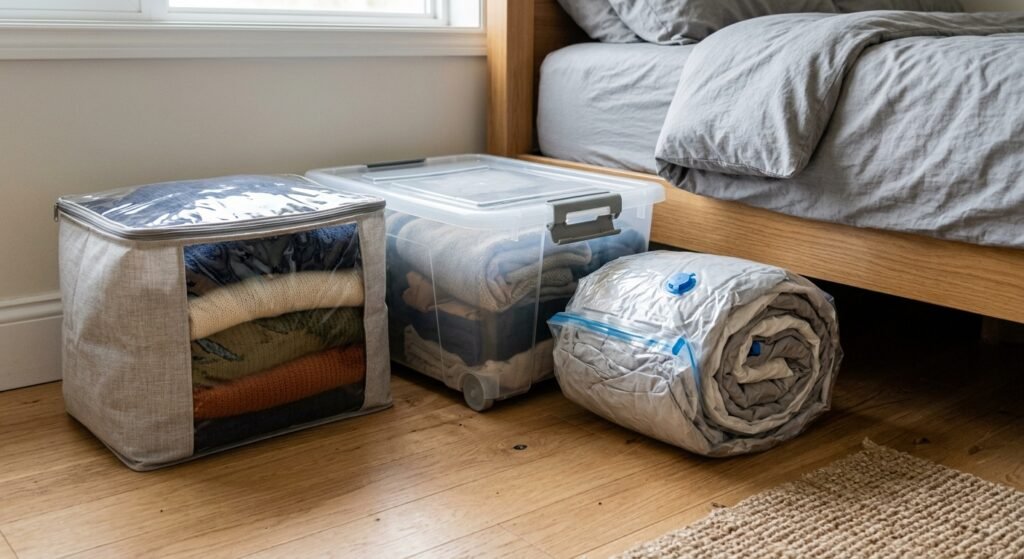
Zippered fabric bags with clear tops. Cheap, flat, and perfect for duvets, pillows, and off-season clothes. The clear window means you’re not dragging out three bags to find the winter jumpers. They squash a bit, which is actually handy under low frames. The zips on the very cheapest ones fail fast, so this is one place spending an extra couple of dollars pays off.
Plastic bins with wheels and clamping lids. The workhorse. Wheels matter more than you’d think, because a loaded bin without them drags on carpet and you’ll stop bothering. Clamping lids keep dust and bugs out. Get two or three matching ones rather than a mismatched collection, since they’ll slide in and out past each other cleanly.
Vacuum storage bags. For pure bulk compression, nothing beats them. A whole duvet shrinks to the thickness of a folded towel. Two warnings from how these tend to go: they slowly reinflate over months as tiny leaks let air back in, so don’t rely on the compressed size being permanent, and never vacuum-pack anything with feathers or wool long-term without checking it now and then, since compression can damage loft.
Shallow trays or drawers for shoes. A low tray with a lid keeps off-season shoes paired and dust-free. Loose shoes under a bed become a lost-and-found within a month.
Your own suitcases. The most overlooked idea on this list. Suitcases have to be stored somewhere anyway, so store them full. Off-season clothes inside the big case, the small case inside the big one if they nest. Free storage you already own.
What Belongs Under the Bed (And What Doesn’t)
Good candidates share two traits: used rarely, and not damaged by being ignored.
- Off-season clothing and coats
- Spare duvets, blankets, and guest bedding
- Luggage and travel gear
- Wrapping paper and gift supplies (a flat tray keeps rolls from crushing)
- Books you’re keeping but not reading
- Hobby gear you use monthly or less
And the do-not-store list, learned the annoying way by plenty of people:
- Anything you use weekly. If you’re pulling a bin out every few days, it belongs in the wardrobe, not under the bed. Friction kills the system.
- Food of any kind. Even sealed. It invites pests to a dark, undisturbed spot, which is exactly where they want to live.
- Important documents or electronics in non-sealed containers. Dust and floor-level humidity get to them.
- Damp anything. A slightly damp towel or swimsuit packed away under a bed is how you meet mildew. Everything goes in bone dry.
No Clearance? Raise the Bed
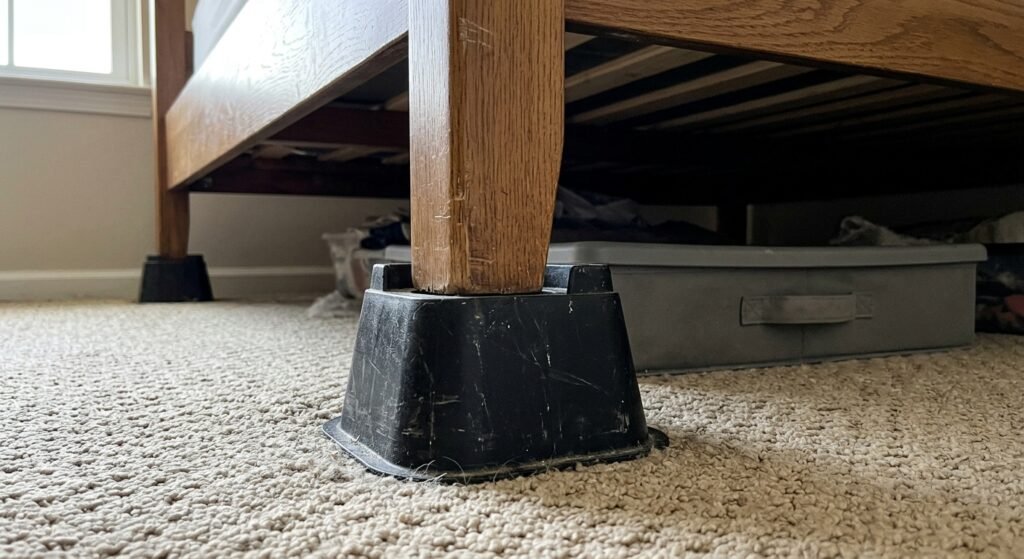
If your frame sits nearly on the floor, bed risers fix that for around $15. They’re stackable cups or blocks that sit under each leg and lift the bed 8 to 15 cm, instantly creating storage where there was none. A few practical notes:
- Buy risers rated well above your bed’s weight, and check every leg sits fully centered in its cup. A half-seated riser is how beds fall off them.
- Beds with a low center rail or platform slats that hang below the frame won’t gain usable space from risers. Check before buying.
- On hard floors, risers with rubber bases stop the bed skating when you sit down on the edge.
A raised bed with a bed skirt or a longer duvet drop hides everything underneath, which is the “out of sight” part of this whole plan. If your bedroom storage problem is bigger than one bed can solve, pair this with the vertical tricks in our small closet organization guide, because closet and under-bed storage cover each other’s gaps nicely.
Keep It From Becoming a Junk Drawer You Sleep On
Under-bed storage fails in one specific way: loose items shoved under “just for now.” Once one thing goes under uncontained, the space is doomed. A few habits prevent it:
- Containers only. Nothing goes under the bed outside a bin or bag. No exceptions, even for now.
- Label the ends. Write on the side that faces out, so you can read it lying on the floor with a phone torch.
- One category per container. Winter clothes bin, bedding bag, gift wrap tray. Mixed bins are where things go to disappear.
- Vacuum under there when you rotate seasons. Twice a year, everything slides out, the floor gets vacuumed, and the new season’s bins slide in. Dust builds up shockingly fast in that dead-air zone, and it’s also your chance to spot any damp or pest issues early.
The seasonal rotation is honestly the pleasant part. Twice a year your wardrobe effectively doubles for free, and the swap takes twenty minutes once the bins exist. It pairs well with a proper entryway reset too, since coats and boots follow the same rhythm. We covered that in entryway organization for small spaces.
FAQs
Does storing things under the bed cause mold?
Not by itself. Mold needs moisture, so the risks are packing things away damp, storing against an exterior wall’s cold floor in a humid room, or blocking airflow completely in an already damp bedroom. Everything dry going in, sealed containers, and a check during seasonal rotation keeps it a non-issue for almost everyone. If your bedroom already has condensation problems, deal with that first.
Is it bad feng shui or bad for sleep to store stuff under the bed?
If tidy, contained storage under the bed bothered sleep, half the world’s small-apartment dwellers would never rest. What genuinely can affect how the room feels is visible chaos, so keep it contained and hidden and you get the storage without the clutter feeling. If it bugs you personally, stick to soft, calm categories like bedding rather than paperwork.
What’s the best option for a bed with drawers built in?
Use them, they’re better than anything you can buy, but treat each drawer as one category and line them with a cheap sheet of shelf liner so fabric doesn’t snag on raw wood inside. Built-in drawers usually seal worse than lidded bins, so keep the dust-sensitive stuff in zip bags inside the drawers.
How do I stop bins sliding around under a slatted bed?
On hard floors, felt pads under bins that don’t have wheels, or just choose wheeled bins that roll straight out. The real trick is not overfilling the space. Leave a hand’s width between containers and they’ll come out without a wrestling match.
Can I store books under the bed long-term?
Yes, and it’s one of the better spots since it’s dark, which protects spines from fading. Pack them flat in smaller bins rather than one huge one, because a large bin full of books is genuinely too heavy to slide out. Toss in a silica gel packet or two if your bedroom runs humid.