
You can hang heavy things without drilling a single hole, but only if you match the hanger to the real weight and prep the wall properly. Adhesive strips genuinely hold up to about 7 kg (16 lb) per set when applied to a clean, smooth wall. Beyond that you move up to adhesive rail systems, brick clips, or tension-based solutions, which can carry mirrors and shelves north of 15 kg. The two reasons no-drill hangers fail are almost never the product: it’s dusty walls and impatience with cure times.
That failure usually happens at 3 a.m. three weeks later, with a crash, which is why most people who “tried those strips once” don’t trust them. Follow the prep and weight rules below and they’re reliable enough for a large framed mirror. Skip the prep and nothing on this page will save you.
First: Weigh the Thing (Really)
Everyone guesses weight, and everyone guesses low. Stand on a bathroom scale holding the mirror, subtract your weight, done. A “medium” framed mirror is often 8 to 10 kg, which is already past what a single set of strips is rated for. Knowing the true number tells you which section below applies, and it’s the difference between confident hanging and wishful thinking.
Rough reference points:
- Framed photo, A4 to A3 size: 0.5 to 2 kg
- Large canvas print: 1 to 3 kg (canvases are lighter than they look)
- Framed mirror, 60 × 90 cm: 7 to 12 kg
- Floating shelf plus books: 10 kg and up, fast
- Large TV: 8 to 15 kg, and no adhesive product is rated for TVs, full stop
Option 1: Adhesive Strips (Up to ~7 kg / 16 lb)
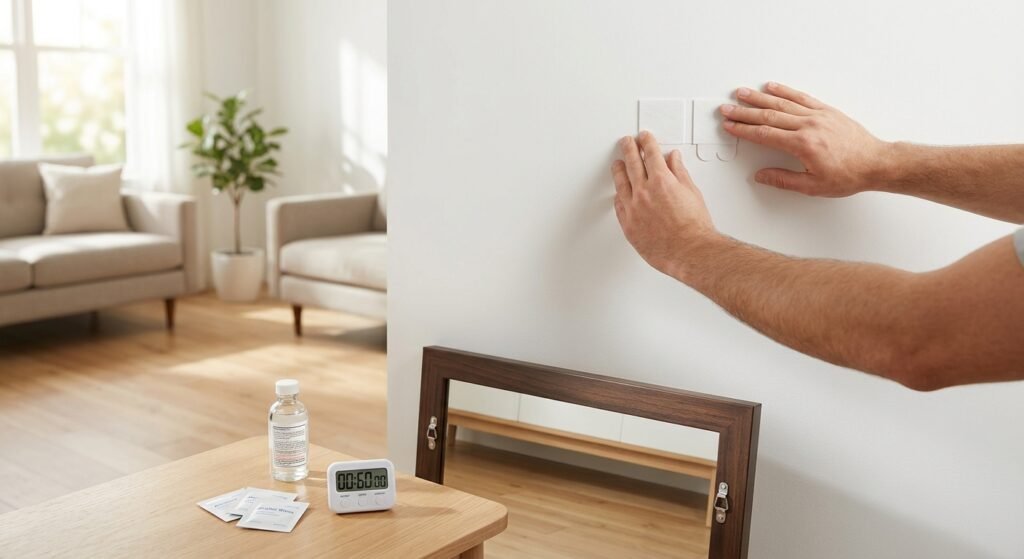
The interlocking “velcro-style” strips are the workhorse. The large size is rated at 7 kg per set of four pairs, and in practice they hit that rating if, and only if, you follow the boring instructions exactly.
- Clean the wall with rubbing alcohol, not household cleaner or a wet wipe. Cleaning sprays leave a slip-resistant film that adhesive hates. Wipe, let it dry fully.
- Press each strip to the wall for a full 30 seconds with real pressure. Count it out, it’s longer than you think.
- Then wait one hour before hanging anything. This is the step everybody skips and it’s where most 3 a.m. crashes are born. The adhesive builds strength as it cures.
- Distribute strips to the corners of the frame, not just the top edge. Bottom strips stop the frame swinging and peeling the top ones.
Surface matters as much as weight. Strips grip painted drywall, glass, tile, sealed wood, and metal. They fail on textured walls, wallpaper, brick, and fresh paint under a month old. On rough or textured walls, no strip works well, so jump to the rail or clip options.
Cold makes adhesive lazy too. If the room is under about 10°C, warm the wall spot with a hairdryer for a few seconds before pressing the strip on.
Option 2: Adhesive Hooks and Rail Systems (7 to ~15 kg)
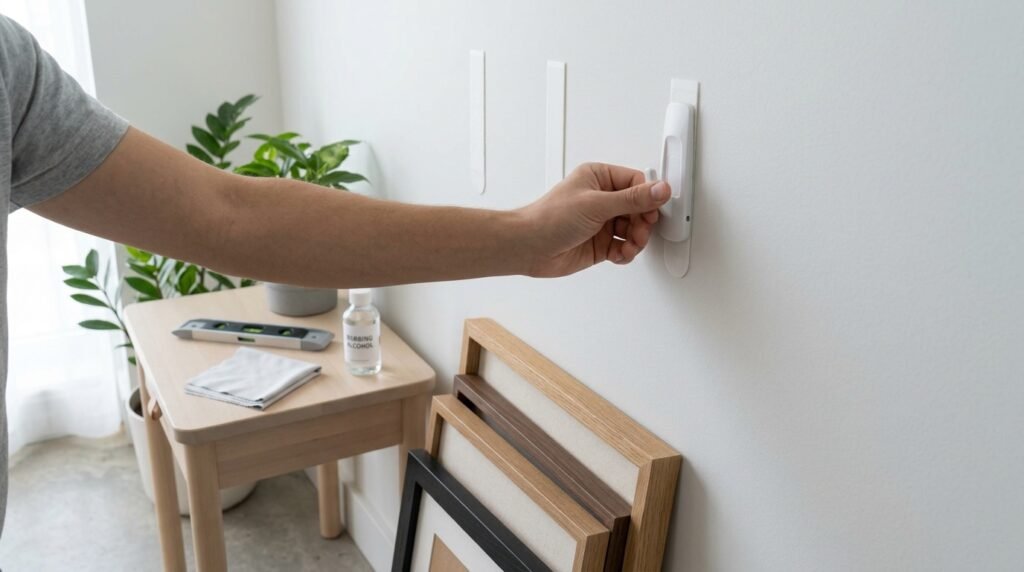
For the genuinely heavy stuff, single hooks tap out, but systems that spread the load keep going.
- Heavy-duty adhesive hooks rated 5 to 10 kg exist, and the good ones use a wide adhesive pad plus a hook that directs the load straight down. Straight-down load is the key: adhesive is strong in shear (sliding down the wall) and weak in peel (pulling away from it). A hook that levers away from the wall at the top will fail at half its rating.
- Adhesive rail systems use two or more horizontal rails stuck across the wall, with the picture hanging from adjustable hooks on the rails. Because the load spreads across a long adhesive line, quality systems carry 10 to 15 kg. This is the no-drill answer for that big mirror.
- Double up and overspec. Use twice the rated capacity you need. If the mirror is 8 kg, rig for 16. Adhesive ratings assume perfect application on perfect walls, and your wall is not perfect.
One habit worth stealing from picture framers: after hanging something heavy on adhesive, give it a firm downward tug and then leave it empty-checked for 24 hours before walking away. If a bond is going to creep, it usually shows early.
Option 3: Brick Clips, Rail Moulding Hooks, and Other Grippers
Some walls come with built-in hanging features that people forget about.
- Brick clips spring-grip the edges of an exposed brick and hold 10 to 15 kg each with zero adhesive and zero drilling. Measure your brick height first, since clips come sized.
- Picture rail hooks. Older apartments often have a wooden moulding running near the ceiling. Brass hooks slot over it and hold serious weight on cords or chains. If you’ve got a picture rail, it beats every adhesive product on this page.
- Door and cabinet hooks hang over the top edge of a door and carry mirrors, coats, and organizers up to around 10 kg. Check the door top for enough clearance to close.
- Skirting-to-ceiling tension poles wedge between floor and ceiling and take shelves, plants, and even TV mounts on some models. Completely hole-free and surprisingly rigid when installed plumb.
Option 4: Stop Hanging, Start Leaning
For the heaviest items, the most renter-safe trick is to not fight gravity at all. A full-length mirror leaned against the wall is a designer look at this point, not a compromise. Large art sits beautifully on the floor against a wall, on a deep shelf, or on the mantel. Add a discreet anti-slip pad under the bottom edge and a single adhesive strip behind the top corner to stop tipping, and you’ve “hung” 20 kg with hardware rated for 2.
If there are kids or pets in the home, that top anti-tip strip isn’t optional. A leaned mirror that can be pulled forward is a real hazard, so secure the top even if it looks stable.
Removing Everything Cleanly Later
This is half the reason you chose no-drill in the first place, so don’t fumble the ending.
- Stretchy-tab strips: pull the tab straight down, parallel to the wall, slowly, until the strip releases. Never pull outward, that’s how paint comes off. If a tab snaps, press a length of dental floss behind the strip and saw gently downward.
- Standard adhesive pads: warm with a hairdryer for 30 seconds, lift a corner, and peel low and slow. Any leftover residue rubs off with a drop of cooking oil or citrus remover, then a soapy wipe.
- On wooden doors and trim, residue needs slightly gentler handling so you don’t dull the finish. Full method here: How to Remove Sticker Residue from Wood.
While you’ve got the alcohol wipes and hairdryer out for wall prep, it’s a good weekend to knock out the other tiny fixes rentals collect, like the door that never stays open: How to Fix a Door That Won’t Stay Open.
What NOT to Do
- Don’t hang a TV on any adhesive product. No manufacturer rates them for TVs, and a falling TV is a different category of disaster than a falling frame.
- Don’t stick anything to fresh paint. Paint needs about four weeks to cure. Adhesive on young paint bonds to the paint, and the paint bonds to nothing.
- Don’t trust textured or wallpapered walls. The strip only grips the peaks of the texture, a fraction of its pad area. Use rails on a smoother section, clips, or the leaning approach.
- Don’t reuse strips. Once separated, the adhesive is spent. New picture, new strips, always.
- Don’t hang heavy things over beds or sofas with adhesive, whatever the rating says. Sleep-adjacent walls deserve mechanical fasteners or nothing.
FAQs
How much weight can command strips actually hold?
The large size is rated at 16 lb (about 7 kg) per set of four pairs, and independent tests back that up on clean, smooth, cured paint. Real-world walls with dust, texture, or cleaning-spray film cut that meaningfully, which is why the alcohol wipe and the one-hour wait matter more than the rating on the box.
Why do my adhesive hooks keep falling off?
Nine times out of ten it’s one of four things: the wall wasn’t cleaned with alcohol, the paint is textured or flat-matte, you loaded the hook within the first hour, or the item levers the hook away from the wall instead of pulling straight down. Fix those and the same hook that failed will usually hold fine.
Can I hang a heavy mirror without drilling?
Up to around 12 to 15 kg, yes, with an adhesive rail system on a smooth painted wall, overspecced to double the mirror’s weight. Heavier than that, or on textured walls, lean it instead with an anti-tip strip at the top. It genuinely looks intentional, and it’s the strongest “mounting” there is.
Will removing adhesive strips take the paint off?
Not if you pull the stretch-tab straight down slowly and keep it parallel to the wall. Paint comes off when people pull the tab outward or rip fast. On old, flaky, or cheap flat paint all bets are off, so test one strip in a hidden spot first if the paintwork looks fragile.
What about picture hanging on plaster walls?
Plaster is actually great news for adhesive, since it’s usually smooth and hard. Clean it, use the standard methods, and you’re set. Old lime plaster with a chalky, powdery surface is the exception, because the surface itself sheds. Wipe a finger across it; if it comes away dusty, use a picture rail or lean the piece.
Pingback: How to Organize Cleaning Supplies in a Small Apartment - The Home Perk
Pingback: Small Apartment Kitchen Organization: Ideas That Actually Work - The Home Perk
Pingback: Apartment Balcony Vegetable Garden for Beginners: Complete Starter Guide - The Home Perk
Pingback: 12 Herbs That Grow In Shade On A Balcony - The Home Perk