
The easiest way to organize cleaning supplies in a small apartment is to stop trying to keep them all in one place. Split them into three small zones instead: a portable caddy with your everyday basics, a bathroom stash under the sink, and a kitchen stash near where you actually use it. Then get rid of everything that doesn’t earn a spot. Most apartments don’t have a utility closet, and pretending one cabinet can hold a whole cleaning aisle is exactly why the space under your sink looks like a bottle graveyard.
This system works in a studio, a one-bedroom, or a shared flat, and you can set it up in an afternoon with maybe $20 of bins and hooks.
Step 1: Dump Everything Out and Cut It in Half
Before you buy a single organizer, gather every cleaning product you own into one spot on the kitchen floor. All of it. The crusty bottles from under the bathroom sink, the duplicate glass cleaner, the specialty product you bought once for a stain in 2023.
Now be honest about what stays:
- Toss anything nearly empty or dried out. A bottle with a centimeter of gunk in the bottom isn’t a supply, it’s clutter.
- Combine duplicates. Two half-empty bottles of the same all-purpose spray become one bottle. Only combine identical products, never mix different cleaners, because some combinations (like bleach and anything ammonia-based) are genuinely dangerous.
- Question the one-job products. If a bottle exists for a single task you do twice a year, ask whether dish soap, white vinegar, or baking soda could do the same job. They usually can.
Most people end up keeping about half of what they started with. That alone solves most of the storage problem before you’ve spent a penny.
Step 2: Build One Grab-and-Go Caddy
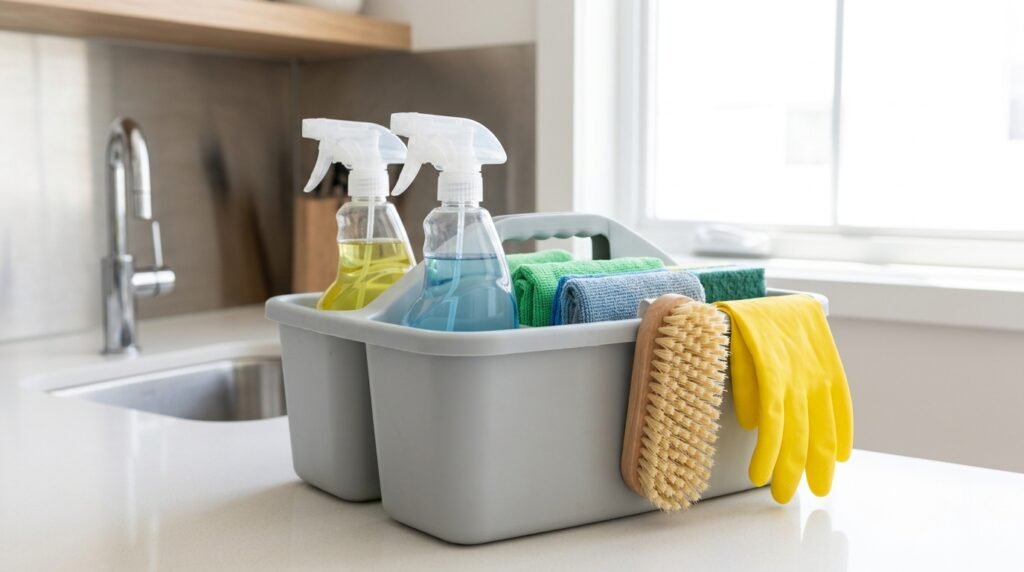
The single most useful thing you can do to organize cleaning supplies is put your everyday products in a plastic caddy with a handle. Cleaning day stops being ten trips back and forth across the apartment. You grab the caddy, clean a room, move on.
A good basic caddy holds:
- All-purpose spray
- Glass or mirror cleaner
- A couple of microfiber cloths
- A scrub sponge or brush
- Disinfectant wipes or bathroom spray
- Rubber gloves stuffed down the side
That’s it. If the caddy is overflowing, you’ve put storage in it instead of tools. Park it under the kitchen sink or on a shelf, wherever it’s easiest to grab. Dollar-store caddies work fine, though the ones with a taller handle are noticeably easier to carry when it’s loaded.
Step 3: Set Up Your Three Zones
With the caddy handling the everyday stuff, everything else gets stationed where it’s used. Walking to another room for a product is how cleaning jobs get skipped.
Zone 1: Under the kitchen sink
This is home base. The caddy lives here, plus dishwasher tablets, extra sponges, bin bags, and backup bottles. Two cheap additions transform this cupboard:
- A tension rod across the top lets you hang spray bottles by their triggers, which frees the whole floor of the cabinet. Measure the width first, and give the rod a firm tug after installing because a loaded rod that slips will take every bottle down with it.
- A small stacking shelf or two-tier organizer doubles the usable space underneath.
If your under-sink area is a tangle of pipes, look for U-shaped organizers designed to fit around them.
Zone 2: The bathroom
Keep a second, tiny kit here: toilet cleaner, a bathroom spray, and a cloth or two. A small bin under the bathroom sink or a shower caddy hung inside the vanity door is plenty. When bathroom supplies live in the bathroom, a quick sink wipe-down actually happens. We’ve got a whole separate guide on making that cramped vanity cabinet work: Under-Sink Organization for a Small Bathroom (link goes live once that article is published).
Zone 3: The tall stuff
Brooms, mops, and the vacuum are the awkward ones in an apartment. A few renter-friendly options:
- A wall-mounted broom gripper strip inside a closet or behind a door. Most screw in with two small screws, and there are adhesive versions if you can’t drill. For adhesive mounts on painted walls, check our guide on how to hang heavy things without drilling first, because a falling mop at 2 a.m. is a special kind of jump scare.
- The gap beside the fridge. A surprising number of vacuums and ironing boards fit in that 10 cm slot.
- Behind a door. An over-door hook holds a lightweight stick vacuum or dustpan set out of sight.
Step 4: Use Your Doors and Walls
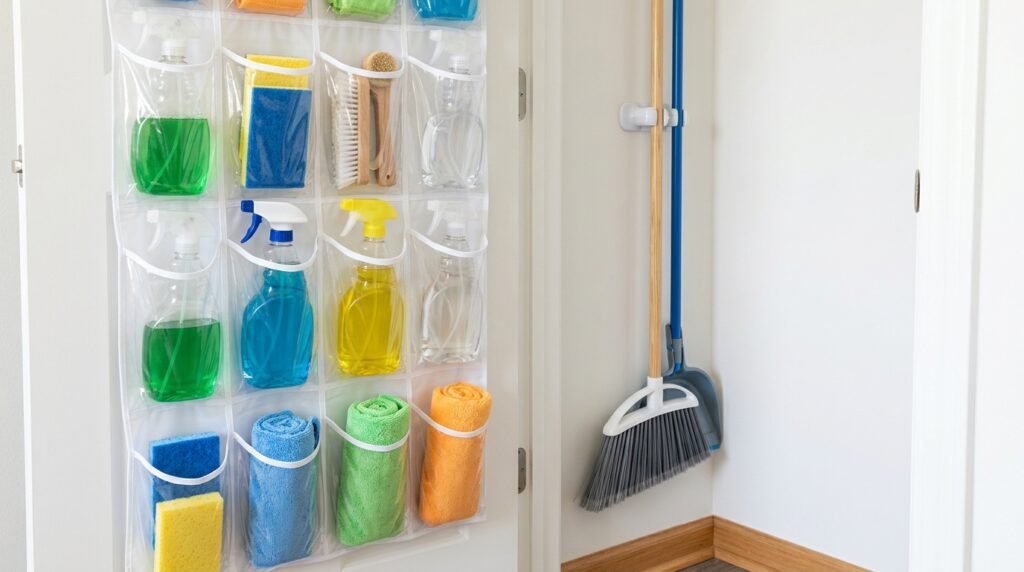
Cabinet floors fill up fast. Vertical space almost never does.
- Over-cabinet-door baskets hook over the door and hold sponges, gloves, or brushes with zero installation.
- Adhesive hooks inside cabinet doors hang small brushes, a dustpan, or rolled-up rubber gloves.
- An over-door shoe organizer on the inside of a closet door is the classic renter trick. Each clear pocket holds one bottle or a bundle of cloths, and you can see everything at a glance. It looks a bit chaotic at first, but it holds more than an entire cabinet.
None of these require a drill, which matters when your deposit is on the line.
Step 5: Keep It From Sliding Back Into Chaos
An organized cupboard decays fast without a couple of small habits:
- One in, one out. New bottle of something comes home, the old empty leaves.
- Refill, don’t multiply. Buying concentrate refills for your spray bottles is cheaper and stops the bottle collection from growing.
- Do a five-minute purge every few months. Usually when you notice the caddy getting heavy.
Also label anything you decant into plain bottles. A masking-tape label and a marker is fine. Future you, half asleep and reaching for glass cleaner, will thank present you.
If your kitchen cupboards are the real bottleneck, the fix is usually the same vertical-space thinking applied to pots and pantry goods. There’s a full room-by-room version in our small apartment kitchen organization guide (link works once that article is published).
FAQs
Where should I keep cleaning supplies if I have no under-sink space at all?
Go vertical. An over-door shoe organizer on a closet or laundry door holds a shocking amount, and a slim rolling cart can slide into a 15 cm gap beside the fridge or washing machine. Worst case, a lidded plastic tub on the floor of a wardrobe works fine, just keep the everyday caddy somewhere you can grab it without moving things.
Is it safe to store cleaning products in the kitchen near food?
Yes, as long as they’re sealed and separated. Keep chemicals below food storage, never above it, so a leak drips onto the cabinet floor instead of your pasta. And never move cleaners into old food or drink containers. That’s the one storage shortcut that genuinely sends people to the ER.
How do I organize cleaning supplies with a toddler or pets around?
Anything toxic goes up high or behind a childproof latch, full stop. The cheap adhesive-strap cabinet locks work fine on rental cabinets and peel off later without damage. A good compromise is keeping the harsh stuff (bleach, drain cleaner, oven cleaner) in one latched or high cabinet and letting the mild stuff live under the sink.
Do I really need a caddy, or is that just organizer-influencer stuff?
You don’t need one, but it’s the cheapest habit-changer on this list. The real point is that your core products travel as one unit. A bucket works. A sturdy tote bag works. It just needs a handle and it needs to live in the same spot every time.
How many cleaning products does a small apartment actually need?
Fewer than you’d guess. An all-purpose spray, dish soap, a bathroom or disinfectant cleaner, glass cleaner, and something for floors covers 95 percent of jobs. Add white vinegar and baking soda and you can handle most of the weird stuff too. Everything past that is optional.
Pingback: Small Apartment Kitchen Organization: Ideas That Actually Work - The Home Perk