
Good small apartment kitchen organization comes down to one rule: the counter is for working, not storing. Everything else in this guide flows from that. When you’ve got four cupboards, two drawers, and a strip of counter the size of a bath towel, the goal isn’t to fit more stuff in. It’s to move storage up onto walls and doors, put the things you use daily within arm’s reach, and evict everything you haven’t touched in a year.
Nothing here requires drilling into tile or asking a landlord for permission, and most of it costs less than a takeaway order.
Start With a Ruthless Cull
Every small kitchen guide says declutter first, and everyone skips it. Don’t. In a big kitchen, a gadget you never use just sits there. In a small one, it actively blocks something you use daily.
Pull everything out of one cupboard at a time and sort into three piles:
- Daily and weekly stuff goes back into the easiest-to-reach spots.
- Monthly stuff (the big stockpot, the baking tins) goes up high or down low.
- “Someday” stuff goes in a box. Seal it, date it, shove it in a closet. If you haven’t opened it in six months, donate the box without looking inside. Looking inside is how the waffle maker survives another year.
Duplicates are the quiet space-killers. Nobody with two drawers needs three spatulas, two can openers, and nine mugs.
Go Vertical: Walls, Doors, and the Dead Air Above Things
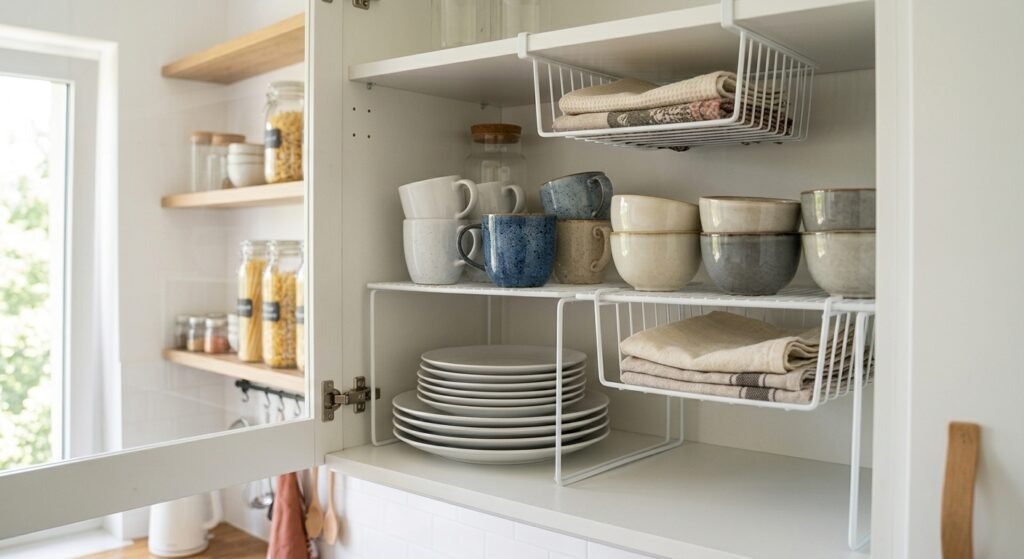
Small kitchens almost always have empty wall space and half-empty cupboards at the same time, because everything’s piled on one shelf while the air above it does nothing.
- Shelf risers are the highest-value item in this whole article. A $5 wire riser instantly turns one shelf into two. Put plates under, bowls and mugs on top.
- Under-shelf hanging baskets clip onto an existing shelf and catch the dead space beneath it. Great for mugs, napkins, or sandwich bags.
- Adhesive hooks inside cupboard doors hold measuring spoons, oven mitts, and small chopping boards. The inside of a cabinet door is prime real estate that’s empty in most kitchens.
- A rail with S-hooks on the wall or backsplash holds utensils and small pans. Adhesive rails work on smooth tile. If you’re nervous about weight, our guide on how to hang heavy things without drilling covers what adhesive mounts can genuinely hold, because a cast iron pan is not a job for a $2 hook.
- The top of the fridge and top of the cabinets are fine for rarely used items, in matching bins so it looks intentional instead of like a garage sale.
One warning from the school of hard knocks: wipe tile or painted surfaces with rubbing alcohol before sticking anything adhesive. Kitchen surfaces carry an invisible grease film, and it’s the number one reason “heavy duty” hooks let go a week later.
Fix the Counter Problem
If your counter is buried, cooking becomes miserable and takeout wins. Triage it:
- Only daily appliances live out. Kettle, coffee maker, maybe the toaster. The blender you use on Sundays lives in a cupboard and comes out on Sundays.
- Use a corner, not the middle. Push what remains into the corner near an outlet so the main run of counter stays clear.
- Add counter you don’t have. A cutting board that spans the sink adds a foot of prep space for about $15. A rolling cart parked at the end of the counter adds a whole extra surface plus three shelves, and it moves when you need the floor.
If your kitchen has a chronic grease film problem on the cupboard doors near the stove, sorting that out makes the whole room feel cleaner than any organizer will. Here’s the method: How to Get Cooking Grease Off Painted Cabinets.
Make the Drawers Earn Their Keep
Two drawers means zero tolerance for junk drift.
- Dividers or small trays stop the utensil drawer from becoming a bird’s nest. Cheap bamboo expanders are fine, or honestly, small cardboard boxes cut to height work until you feel like upgrading.
- File your food containers. Store containers with lids on, stacked inside each other only within the same shape family, and stand the odd lids up vertically in a rack or an old magazine holder. Mismatched container chaos eats more drawer space than any other single thing.
- One shallow junk tray, not a junk drawer. Rubber bands, the takeout menus, spare keys. When the tray overflows, it gets emptied. The tray is the boundary.
And if a drawer keeps creeping open on its own every time you walk past, that’s a five-minute fix, not a quirk you have to live with: How to Stop Drawers from Sliding Open.
Organize by Zones, Even in a Tiny Kitchen
Zones sound like something for big kitchens, but they matter more in small ones because steps are wasted space too.
- Prep zone: knives, boards, bowls near your main counter area.
- Cooking zone: pans, utensils, oil, and salt within arm’s reach of the stove.
- Cleaning zone: everything for washing up lives at the sink. Sponges, dish soap, and the bin.
- Coffee/tea corner: mugs, kettle, coffee, and spoons in one spot, ideally directly above or beside the kettle.
The test is simple: can you make coffee, cook pasta, and wash up without crossing the kitchen for anything? If yes, your zones work.
Pantry Storage When There’s No Pantry
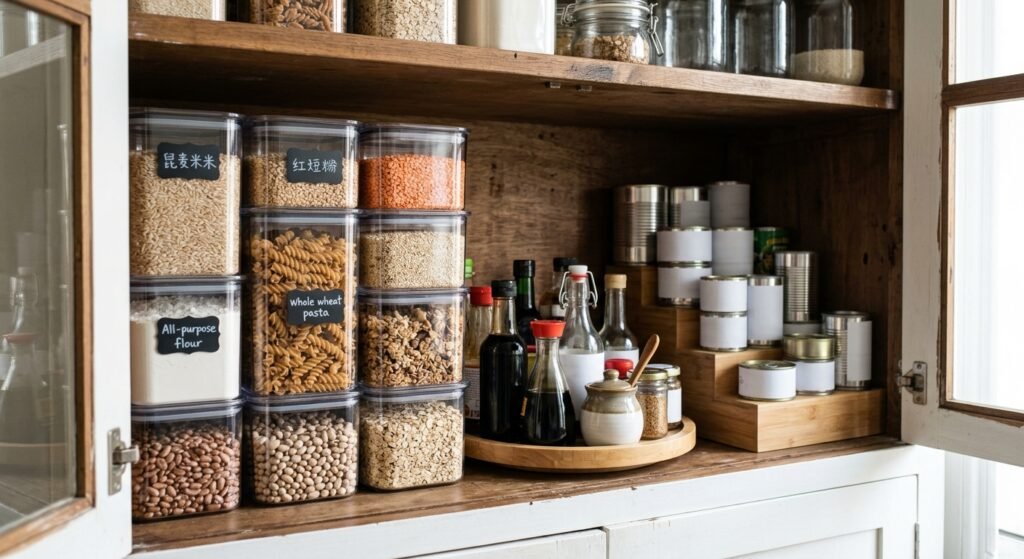
Most small apartments give you one food cupboard, if that.
- Decant the big bags. Rice, flour, and pasta in square clear containers stack properly and stop half-open bags from spilling. Square beats round because round containers waste corner space.
- A lazy Susan turntable in a deep cupboard means no more archaeology to reach the soy sauce at the back.
- Can risers or stepped shelves let you actually see all your tins at once, which stops you buying a fourth tin of tomatoes because the other three were hiding.
- An over-door organizer on a nearby closet door can hold snacks, packets, and spices. It’s not glamorous, but it works, and this same trick handles cleaning products too. We covered that in How to Organize Cleaning Supplies in a Small Apartment.
FAQs
What’s the first thing I should buy for a small kitchen?
Shelf risers, no contest. They’re cheap, they need no installation, and they roughly double your cupboard space on day one. A rolling cart is the best second purchase if you’ve got a spare 40 cm of floor anywhere.
How do I store pots and pans with almost no cupboard space?
Nest them with pan protectors (or folded tea towels) between, and hang the lids on adhesive hooks inside a cupboard door. If you’ve got wall space, a rail with S-hooks holds your two or three most-used pans out in the open. Also, be honest about how many pans you cook with. For most people it’s three.
I rent, so I can’t put holes in anything. What actually sticks?
Modern adhesive hooks and rails hold well on smooth tile, glass, and gloss paint, as long as you clean the surface with rubbing alcohol first and let the adhesive rest an hour before loading it. Matte and textured walls are much less reliable. Tension rods and over-door hardware need no adhesive at all, so lean on those for anything heavy.
How do I keep a small kitchen from getting cluttered again?
The one in, one out rule does most of the work. New mug in, old mug out. Beyond that, do a two-minute counter reset after dinner each night. Small kitchens don’t gradually get messy, they tip over all at once, and the nightly reset stops the tipping.
Is a rolling cart really worth the floor space?
In most kitchens, yes. It’s the only piece of furniture that adds counter space, three shelves of storage, and moves out of the way, all for around $30. Park it as a coffee station, a pantry overflow, or prep space next to the stove. If your kitchen is so narrow a cart blocks the walkway, skip it and go harder on wall storage instead.