
The best vegetables for container gardening share three traits: they stay compact, they don’t mind restricted roots, and they give you a lot of food per pot. That last one matters most on a small balcony. When you’ve only got room for six containers, a plant that produces for months earns its spot, and a cauliflower that occupies a huge pot all season for one single head does not.
Here are the vegetables that consistently earn their space, what size pot each one actually needs, and a few popular crops that honestly aren’t worth growing in containers at all.
The Top Picks, Ranked by Value per Pot
Cherry Tomatoes
The highest reward on the list. One healthy cherry tomato plant in a 40 liter pot can produce for three months straight. Choose bush or “patio” varieties bred for pots, give it your sunniest spot (6+ hours), and push a support cane in at planting time rather than after it flops. Skip full-size beefsteak tomatoes in year one, they’re far less forgiving.
Salad Leaves and Lettuce
The fastest and cheapest win. Loose-leaf varieties grow in anything 15 cm deep, tolerate partial shade, and regrow after cutting. A window box of cut-and-come-again leaves replaces those $4 supermarket salad bags for months. Sow a pinch of seed every two or three weeks so a new batch is always coming.
Bush Beans
Quietly one of the most productive things you can grow in a pot. No trellis needed, no fuss, just a 25 cm deep container and sun. Pick the pods young and the plant keeps making more. If you have a railing or wall for support, climbing beans produce even more from the same footprint.
Radishes
From seed to plate in under a month, which makes them the best confidence-builder in gardening. They need only 15 to 20 cm of depth and cope with some shade. Sow, water, wait three weeks, eat. Then sow again in the same pot.
Peppers and Chillies
Compact, pretty, and well suited to pot life, as long as they get real sun and warmth. A 25 to 30 cm pot per plant is enough. Chillies especially are productive in small spaces, and one or two plants covers most kitchens for the year. In cooler UK-type summers they do best against a warm, sheltered wall.
Zucchini (Courgette)
One plant, one very large pot (40+ liters), and a genuinely absurd amount of food from midsummer on. The classic mistake is planting two “to be safe” and then drowning in zucchini by August. One is enough. It’s thirsty, so this is the pot you’ll water most.
Swiss Chard
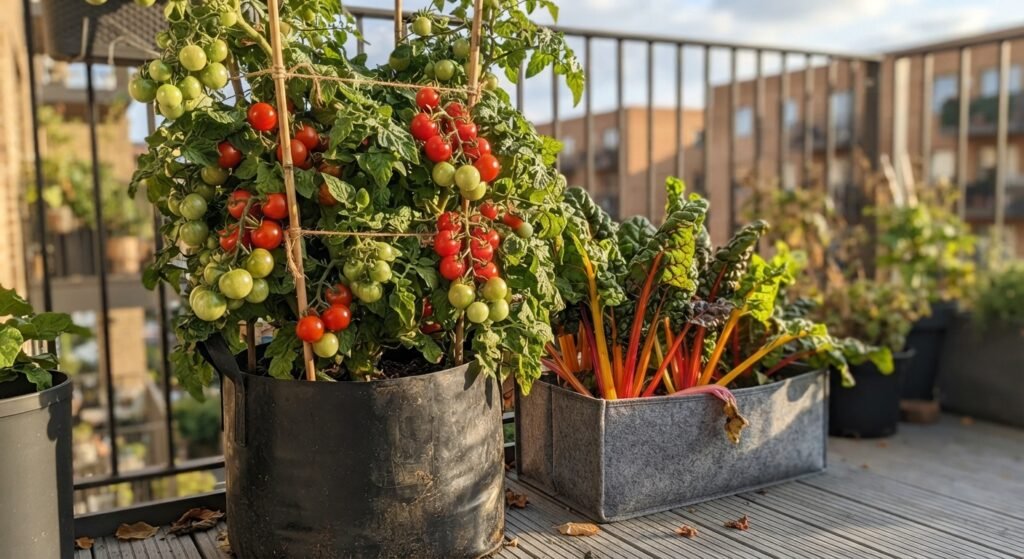
The leafy green that just refuses to quit. It handles heat better than spinach, tolerates partial shade, and one sowing in a 25 cm pot can produce from spring until the frosts if you keep picking outer leaves. The rainbow-stemmed varieties look good enough to double as an ornamental.
Carrots
A surprise container star, because pots give you what garden soil often doesn’t: loose, stone-free growing space, which means straight carrots. Use a container at least 30 cm deep and choose a shorter variety. Thinning the seedlings is fiddly and takes a bit of patience, but skipping it is why people end up with tangled little stubs.
Spring Onions and Garlic Greens
Almost zero effort, tiny footprint. Spring onions grow densely in any small pot. And a few supermarket garlic cloves pushed into soil in autumn give you garlicky green shoots to snip all through spring. Neither will ever be the star of the balcony, but they use up the odd small containers everything else outgrew.
Cucumbers
Worth it if, and only if, you have a sunny spot and can water reliably. A compact bush variety in a 40 cm pot with a small trellis will produce well, but cucumbers punish neglect. Miss two hot days of watering and the fruit turns bitter. Get a self-watering pot for this one if you travel a lot.
What Doesn’t Earn Its Spot
Some vegetables are technically possible in containers but a poor use of a small balcony:
- Sweet corn needs a block of many plants to pollinate properly. A pot of two stalks gives you nothing.
- Cauliflower and cabbage occupy a big pot for months and then give you exactly one head.
- Pumpkins and winter squash will eat your entire balcony and still want more room.
- Full-size potatoes grow fine in deep bags, but the harvest per square meter is small compared to almost everything above. Fun once as an experiment, not a staple.
Nothing wrong with any of these in a garden. In six pots on a balcony, they’re just outcompeted.
Matching Vegetables to Your Conditions
Before you settle on a list, be honest about two things: sun and wind.
For sun, the rough rule is that anything grown for its fruit (tomatoes, peppers, cucumbers, zucchini, beans) wants 6 or more hours, while anything grown for leaves or roots (lettuce, chard, spinach, radishes, carrots) manages on 3 to 5. If your balcony leans shady, build around the leafy end of the list, and consider herbs too, since plenty of them prefer it. Our roundup of herbs that grow in shade on a balcony pairs well with a shade-leaning vegetable list.
Wind matters more on balconies than people expect, especially above the second floor. Tall plants like climbing beans and staked tomatoes take the worst of it, so put them against the building wall, keep pots heavy, and tie stems loosely to their supports. Low growers like lettuce, chard, and radishes barely notice.
And whichever crops you choose, the fundamentals don’t change: real potting mix rather than garden soil, drainage holes in every pot, and containers a size bigger than feels necessary. If you’re starting completely from scratch, our apartment balcony vegetable garden guide for beginners walks through that whole setup step by step.
A Sensible First-Season Combination
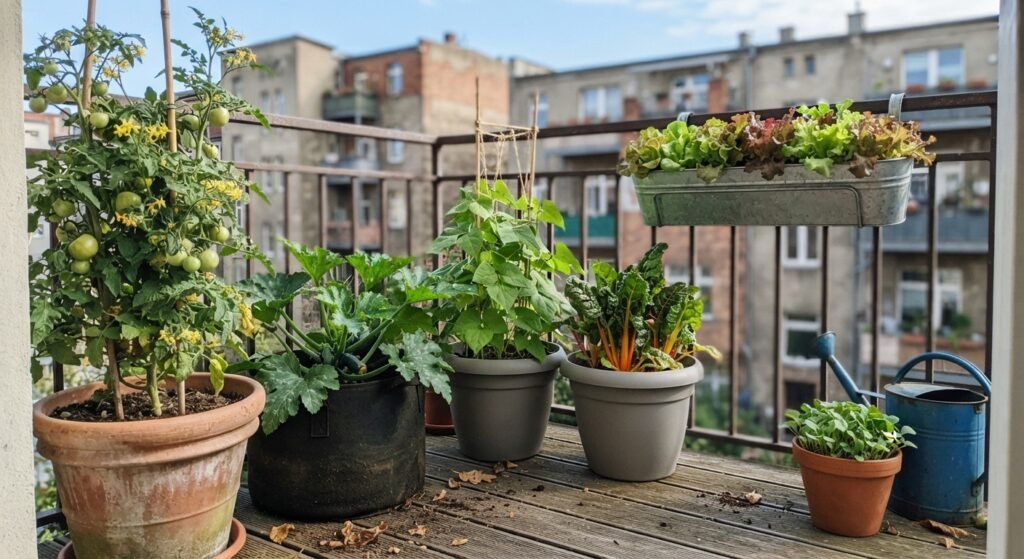
If you want a ready-made shopping list, this six-pot lineup balances speed, yield, and low stress:
- One cherry tomato in a 40 liter pot (sunniest corner)
- One zucchini in a 40 liter pot
- Bush beans in a 25 cm pot
- A window box of cut-and-come-again salad leaves
- Swiss chard in a 25 cm pot
- Radishes now, spring onions later, in whatever’s left
That combination starts feeding you within a month (radishes and salad), peaks in midsummer (beans, tomatoes, zucchini), and keeps going into autumn (chard). It also spreads your risk, so one failed pot doesn’t wipe out the season.
FAQs
What’s the single best vegetable to start with?
Loose-leaf lettuce or radishes. Both are cheap, fast, shallow-rooted, and hard to kill, so you get a win within a month. Cherry tomatoes are the most rewarding overall, but they make you wait until midsummer and give you more chances to fumble along the way.
How many plants can I fit on a small balcony?
More than you’d think, but start with five or six containers. A 1.5 by 3 meter balcony can comfortably hold that plus a railing box or two, with room left to stand. The limiting factor usually isn’t space, it’s how many pots you can keep watered without it becoming a chore.
Can I grow vegetables in buckets and storage boxes instead of proper pots?
Absolutely, and it’s a great way to save money. Any food-safe plastic container works once you drill drainage holes in the bottom, at least four or five decent-sized ones. Old buckets suit tomatoes and peppers well. Avoid containers that previously held chemicals or paint.
Do container vegetables need different fertilizer than garden ones?
Same nutrients, more often. Every watering flushes a little food out of the pot’s drainage holes, so container crops run out weeks before garden crops do. A liquid vegetable feed every one to two weeks from about six weeks after planting keeps everything producing.
Which vegetables can share a pot?
Pair a deep-rooted plant with shallow ones: a tomato underplanted with lettuce or basil works nicely, and the lettuce appreciates the light shade. Avoid pairing two hungry, big plants like zucchini and cucumber in one pot, they’ll fight over water and both lose.