
To remove hard water stains from toilet bowls, you need an acid, not bleach. Those brown and grey rings are mineral deposits, mostly calcium and lime, left behind as water evaporates. Bleach whitens the stain slightly and does nothing to the minerals, which is why the ring comes back a week later looking smug. White vinegar, citric acid, or a pumice stone will actually dissolve or lift the deposit, and none of them will fill your bathroom with fumes.
This works whether you’re dealing with a faint ring at the waterline or years of buildup under the rim. It’s cheap too. The whole kit is vinegar, baking soda, maybe a bag of citric acid, and a few hours of soaking time.
First, Understand What You’re Fighting
Hard water carries dissolved minerals. Every flush leaves a microscopic layer behind, and over months those layers build into visible rings, usually at the waterline and under the rim where water trickles constantly. Rust-colored stains mean there’s iron in your water too.
The reason this matters: minerals dissolve in acid. That’s the entire strategy. Anything acidic enough, given enough contact time, will break the deposit down. The two variables you control are strength of the acid and how long it stays in contact with the stain. Weak acid plus a long soak beats strong chemicals plus impatience.
One safety note before anything else. Never mix cleaning products in the bowl. Vinegar plus bleach makes chlorine gas, which is genuinely dangerous in a small bathroom. Pick one method, finish it, flush thoroughly, then try another if needed.
Method 1: The Overnight Vinegar Soak
This is the gentlest option and the right starting point for waterline rings.
- Turn off the water at the valve behind the toilet and flush once. This drops the water level so the stain isn’t sitting underwater diluting your vinegar.
- Pour in 2 to 3 cups of white vinegar, aiming for the stained areas. Soak paper towels in vinegar and press them against stains above the waterline, including under the rim.
- Leave it overnight, or at least 3 to 4 hours. This is the part that takes patience. Vinegar works, but slowly.
- In the morning, scrub with a toilet brush. The softened deposits usually break up easily.
- Turn the water back on and flush.
For a bit more power, sprinkle a cup of baking soda in after the vinegar has soaked for an hour, let it fizz, then scrub. If you’ve read our guide on removing hard water stains from a black faucet, this is the same chemistry, just scaled up for porcelain.
Method 2: Citric Acid (Stronger, Still Gentle On You)
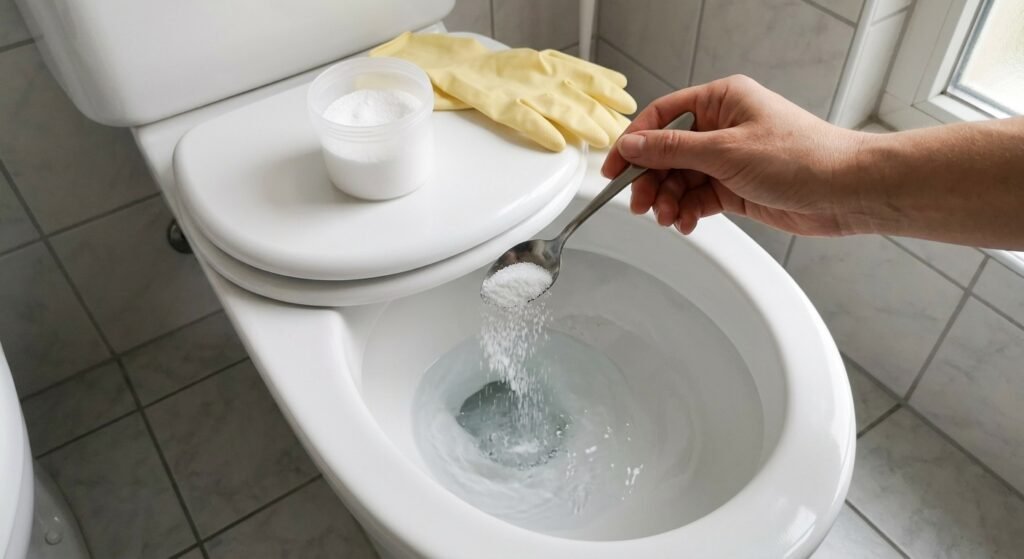
Citric acid powder is sold cheaply as a descaler in most supermarkets and online, and it’s noticeably stronger than vinegar while still being safe to handle and septic-friendly.
- Boil a kettle, let the water cool for a couple of minutes, then pour it into the bowl. Warm water speeds up the reaction. Don’t pour actual boiling water into cold porcelain, because the shock can crack it.
- Add 2 to 3 heaped tablespoons of citric acid powder and swish it around with the brush.
- Leave it for at least an hour. For heavy buildup, leave it overnight.
- Scrub and flush.
What tends to happen with citric acid is that stains that laughed at vinegar simply dissolve. It’s also great for the invisible buildup in the siphon jets under the rim, which is often why a toilet flushes weakly. If your shower has the same crusty mineral problem, the approach in our glass shower door hard water guide pairs well with a citric acid habit.
Method 3: The Pumice Stone (For Stubborn, Ancient Rings)
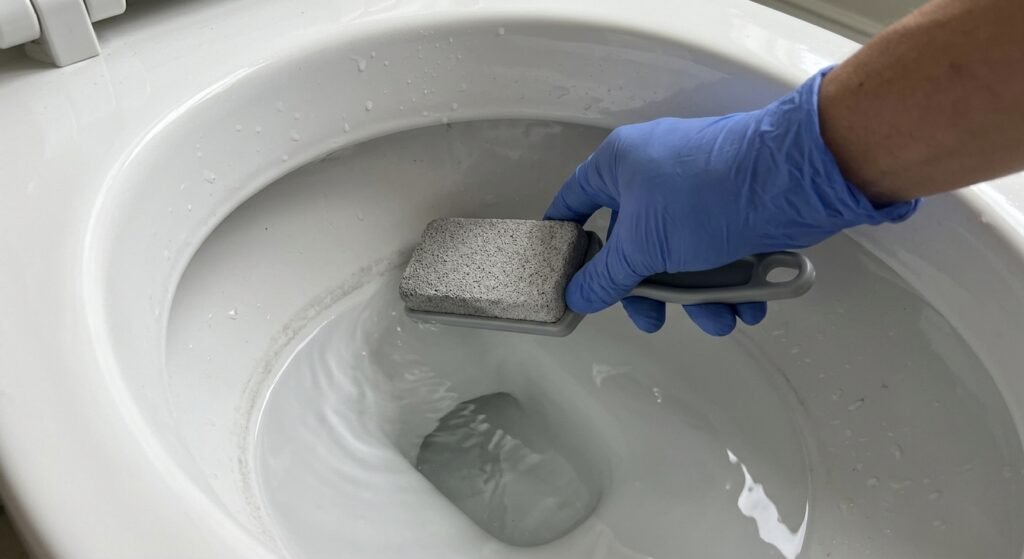
When you move into a place where the ring has clearly been developing since a previous tenant, chemistry alone might not cut it. A pumice stone scrubs mineral deposits off porcelain without scratching, as long as you follow one rule: keep everything wet.
- Buy a pumice stone made for cleaning, ideally one on a handle.
- Soak the stone in water for a few minutes. Never use it dry.
- Rub the stain gently with light pressure. You’ll feel it grinding the deposit off. Grey smudges are the pumice wearing down, and they rinse away.
- Rinse and check your progress often.
Pumice is softer than porcelain but harder than mineral deposits, which is why this works. Two warnings though. Don’t use it on plastic, fiberglass, or any colored or coated toilet, and don’t press hard. Let the stone do the work. If you’re nervous, test a small hidden spot near the back of the bowl first.
What About Under the Rim?
The underside of the rim collects the worst buildup because water constantly trickles over it and it’s impossible to see. Two tricks:
- The paper towel wrap. Soak paper towels in vinegar and tuck them up under the rim so they cling to the surface. Leave for a few hours. This keeps acid in contact with a spot gravity usually drains it away from.
- An old toothbrush. After soaking, a toothbrush reaches the jet holes far better than a toilet brush. Wear gloves, obviously.
Angling a small mirror under the rim shows you exactly what you’re dealing with. Fair warning, the first look is usually a bit horrifying.
Keeping the Stains From Coming Back
Removal is the hard part. Prevention is almost effortless:
- Once a week, pour a cup of vinegar into the bowl before bed and let it sit overnight. Thirty seconds of effort, no scrubbing.
- Brush the bowl every few days so deposits never get a foothold. Fresh mineral film wipes off. Month-old film has to be dissolved.
- If your whole home has hard water, spots on taps, cloudy glasses, stiff laundry, the toilet is just one symptom. A weekly vinegar habit across the bathroom keeps everything ahead of the buildup.
Renters, this matters at move-out time too. A stained toilet is one of those things inspection checklists love, and an overnight soak costs a lot less than a deduction from your deposit.
FAQs
How long does vinegar take to remove toilet stains?
For a light waterline ring, an overnight soak plus a scrub usually does it in one go. Heavy buildup can take two or three rounds over a few days. If you’re not seeing progress after the second overnight soak, skip ahead to citric acid or a pumice stone rather than repeating the same thing.
Will vinegar or citric acid damage the toilet or the seals?
Not at the concentrations we’re talking about. Porcelain is glazed and handles mild acids fine, and an overnight soak now and then won’t bother the rubber seals. What you want to avoid is strong industrial acids like undiluted hydrochloric acid, which can damage seals, pit chrome nearby, and burn you.
Can I use Coke to clean the toilet?
It sort of works, because cola contains phosphoric acid. But it’s a weak acid mixed with a lot of sugar, so you’re basically paying more for a worse vinegar that leaves a sticky film. Vinegar or citric acid is cheaper and noticeably more effective.
Why do the stains keep coming back so fast?
Because the minerals are in your water, so every flush restarts the clock. You can’t stop the deposits arriving, you can only stop them accumulating. That’s why the weekly vinegar habit works so well. It dissolves each week’s microscopic layer before it hardens into next month’s ring.
Are hard water stains a hygiene problem?
Not really. Mineral deposits are unsightly but not dirty in themselves. The catch is that their rough surface gives grime and bacteria something to grip onto, so a scaled-up bowl gets genuinely dirty faster than a smooth one. Cleaner porcelain stays cleaner, if that makes sense.