
Entryway organization for small spaces starts with accepting one thing: you probably don’t have an entryway. In a lot of apartments the front door opens straight into the living room or the kitchen, and there’s no hallway, no closet, and about sixty centimeters of wall to work with. That’s fine. You don’t need a real entryway. You need a drop zone, which is just a defined spot where keys, shoes, bags, and mail land the second you walk in, instead of spreading across every flat surface in the flat.
The whole setup below costs under $60 at the top end, needs no drilling if you don’t want any, and fits in a strip of wall narrower than your front door.
First, Decide What Actually Lands at Your Door
Before buying anything, stand at your front door and think about what’s in your hands when you walk in. For most people it’s some mix of:
- Keys and a wallet or phone
- A bag or backpack
- Shoes
- A coat, most of the year
- Mail you’ll deal with “later”
- Dog leash, umbrella, reusable shopping bags
That’s the list your entryway has to handle. Not seasonal decor, not twelve pairs of shoes, not your entire coat collection. Just the daily stuff. Everything else lives deeper in the apartment. Getting strict about this is what makes a tiny entryway work, because a 60 cm wall can absolutely handle six things. It cannot handle everything you own with a strap on it.
The Core Setup: Hooks, a Tray, and Somewhere for Shoes
If you only do three things, do these.
Hooks at two heights. A row of adhesive hooks at shoulder height takes coats and bags. A second hook lower down, around hip height, is for the dog leash or a kid’s backpack. Command-style hooks rated for 2 kg or more hold a winter coat fine, but press them on clean paint and wait the full hour before loading them. That waiting part matters more than the packaging makes it sound. If you hang a heavy coat straight away, the adhesive tends to creep and the hook lets go a week later, usually at night, which is a great way to think someone’s broken in.
A tray or small bowl for keys. Boring, but this is the single highest-impact item in the whole entryway. Keys go in the bowl. Always. It takes about a week to become automatic, and then you stop losing your keys forever. A slim floating shelf on adhesive strips works if you have zero furniture space, or the top of the shoe storage below.
Shoe storage with a hard limit. A slim shoe rack, a two-tier bench, or even a sturdy basket. The rule is that it only holds the shoes you’re wearing this week, maybe three or four pairs per person. The rest go in the wardrobe. An over-door shoe organizer on a nearby closet door catches the overflow without eating floor space.
If you’re nervous about adhesive hooks on your particular walls, or you want to hang something heavier like a mirror or a small shelf, we’ve covered the sturdier renter-safe options in our guide to how to hang heavy things without drilling.
No Wall Space at All? Go Freestanding
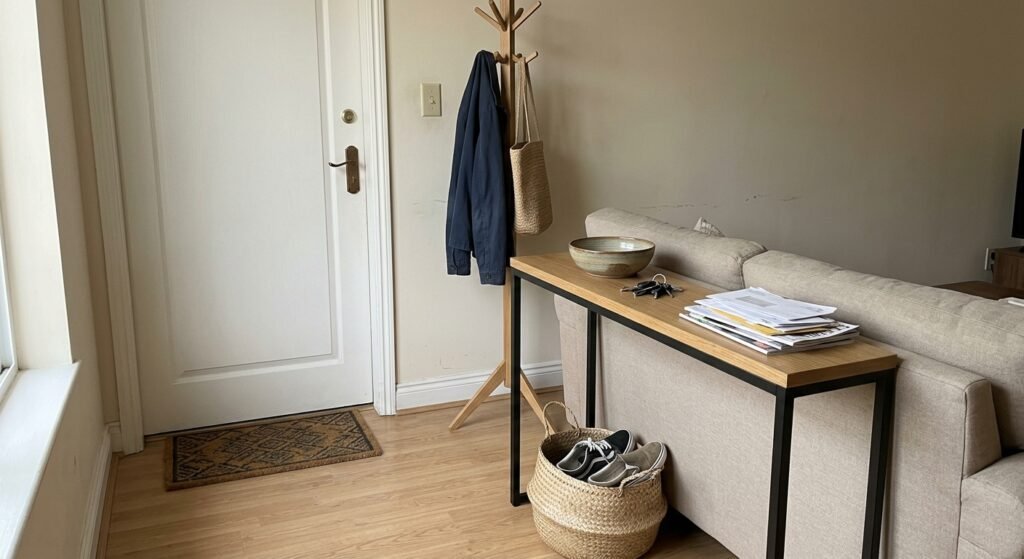
Some layouts genuinely have no usable wall by the door. The door swings one way, a kitchen counter is on the other side, and that’s it. In that case, bring the entryway with furniture instead:
- A slim console table (the 20 to 25 cm deep kind) fits behind a sofa or against the back of a kitchen peninsula. Tray on top, basket underneath for shoes.
- A storage bench does double duty. Shoes inside, a place to sit while putting them on, and a landing spot for bags on top. In a studio, this can also be extra seating.
- A coat rack or garment stand in the corner nearest the door. The freestanding ones need about 40 square centimeters of floor and hold a surprising amount. Pick one with a heavy base, because the cheap top-heavy ones tip over the first time you hang a wet winter coat on one side.
- A rolling cart parked by the door. Top shelf for keys and mail, middle for hats and gloves, bottom for shoes. When guests come, you can roll the whole thing into a closet, which honestly feels like cheating.
Use the Door Itself
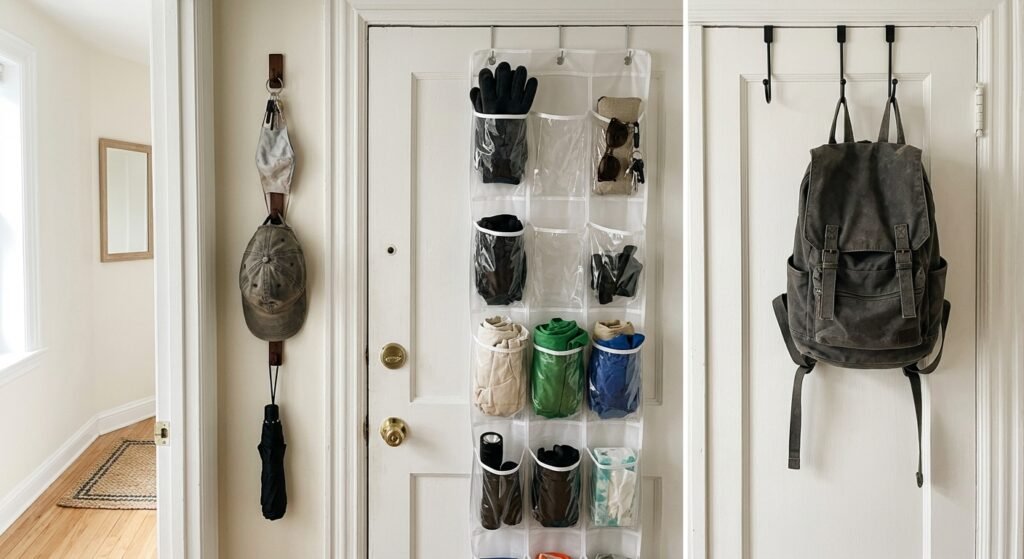
The back of your front door is prime storage that most people ignore.
An over-door organizer with clear pockets holds gloves, sunglasses, dog bags, sunscreen, masks, and all the small stuff that otherwise piles up in a bowl. Over-door hooks (the kind that slot over the top of the door) hold bags and coats with zero adhesive and zero damage, though check the door still closes cleanly with a coat on. On some snug-fitting doors it won’t, and you’ll hear a dragging sound every time it swings.
The wall directly beside the hinge side of the door is often dead space too. Even a 15 cm strip fits a vertical row of single hooks for lanyards, umbrellas, and tote bags.
Handle the Mail Problem Before It Handles You
Paper is the thing that turns a tidy drop zone into a landfill. Give mail exactly one home: a wall pocket, a letter tray, or a magazine file on the console. One slot, not three. Then the rule is simple. Junk goes straight into recycling before it ever gets set down, and everything else goes in the slot. Empty the slot once a week, on the same day, or it quietly becomes an archive.
If your entryway storage is genuinely maxed out and coats are the problem, shift the overflow to wherever your closet lives. Our small closet organization guide covers squeezing more hanging space out of a rental wardrobe for under $50.
Make It Survive Real Life
A drop zone decays without a couple of tiny habits:
- Reset it nightly. Thirty seconds before bed. Shoes on the rack, keys in the bowl, bag on the hook. That’s the whole routine.
- One-week shoe rule. Any pair that hasn’t moved in a week goes back to the wardrobe.
- Seasonal swap. When winter ends, gloves and scarves leave the door pockets and sandals rotate in. Takes ten minutes twice a year.
Also, if you do end up putting a few nails or screws in the wall for a proper coat rail, that’s usually a cheap fix at move-out. Here’s how to fill nail holes in a wall so it never shows.
FAQs
My front door opens directly into the kitchen. Where does the drop zone go?
Wherever the first reachable surface is, even if that’s technically kitchen territory. A tray on the end of the counter for keys, hooks on the side of the nearest cabinet for bags, and a shoe basket tucked beside the fridge gap works fine. The zone doesn’t have to look like an entryway. It just has to be the consistent first stop.
Are adhesive hooks really strong enough for winter coats?
The larger ones rated 2 kg and up, yes, as long as the wall is clean, smooth paint and you let the adhesive cure before hanging anything. Textured walls, wallpaper, and cold damp hallways are where they fail. For a heavy parka plus a bag, use two hooks side by side or an over-door hook instead.
How do I keep the entryway from becoming a shoe pile with kids?
Give each person a labeled bin or basket rather than a shared rack. Kids will toss shoes into a big open basket about 80 percent of the time, which is a much better hit rate than getting them lined up neatly on a rack. Pair it with the one-week rule so the baskets don’t overflow.
What about wet shoes and muddy boots in winter?
A boot tray, which is just a shallow waterproof tray with a lip, sits under or beside the shoe rack. A layer of pebbles in it looks nicer and lets boots drip-dry without sitting in a puddle. In a real cold snap, keep an old towel folded by the door too.
Is a mirror worth the space in a tiny entryway?
Honestly, yes. A slim full-length mirror on the wall or over-door mirror makes the last-check-before-leaving happen at the door instead of a trek back to the bedroom, and it makes a cramped corner feel about twice as big. It’s one of the few “decor” items that earns its spot functionally.