
If you’re wondering how to fix a door that won’t stay open, here’s the quick answer: the door is swinging shut because its hinges aren’t perfectly vertical, and the cheapest cure is the hinge pin trick. You tap one hinge pin partway out, bend it very slightly with two hammer taps, and drop it back in. The added friction holds the door wherever you leave it. Total cost: nothing. Time: about sixty seconds once you’ve done it twice.
That’s fix number one, and honestly it solves most self-closing doors. But it’s not always the right one, especially in rentals or with doors that slam rather than drift, so below are all five options, from zero-cost to about fifteen dollars, plus how to tell which one your door actually needs.
Why Doors Swing Shut on Their Own
A door is a big flat pendulum. If the two (or three) hinges are stacked in a perfectly plumb line, the door balances and stays wherever you put it. Tilt that line even a degree or two and gravity takes over: lean the top of the hinge line into the room and the door creeps shut, lean it out and the door swings open.
The tilt comes from ordinary house life. Buildings settle, door frames rack slightly out of square, hinge screws work loose, and sometimes the door was hung a touch off from day one. In older buildings a self-closing door is almost a certainty somewhere in the flat. None of this means anything is broken. It means you get to pick a fix.
Quick diagnosis: open the door halfway and let go. Drifts shut slowly means a small tilt, and friction fixes work great. Swings shut with intent means a bigger tilt, and you’ll want to shim a hinge or accept a doorstop. And take ten seconds to check for loose hinge screws first, because tightening those fixes a surprising number of “haunted” doors before you try anything else.
Fix 1: The Bent Hinge Pin Trick (Free, 5 Minutes)
The classic, beloved by handymen everywhere because it’s invisible and it works.
- Close the door so the hinges carry no side load.
- Tap one hinge pin up and out. Put a nail or thin screwdriver against the bottom of the pin and tap upward with a hammer. On hinges without a bottom hole, wedge a flathead screwdriver under the pin’s head and lever it up. Middle hinge is the usual choice on a three-hinge door.
- Bend the pin slightly. Lay the pin on a concrete step or hard surface, and give the middle one or two firm hammer taps. You’re after a barely visible bow, a few millimeters at most. It should still look almost straight.
- Tap it back in. It’ll go in stiffer than it came out. That stiffness is the point: the bowed pin presses against the inside of the hinge knuckles and adds constant friction.
- Test. The door should now stay put at any angle but still open and close by hand without groaning. Too stiff? Pull the pin and straighten it a little. Not enough? Bend a second hinge’s pin too.
Two cautions. Don’t do this on hinges with decorative finials that hide the pin, and go gently on cheap hollow-core doors with lightweight hinges, since a heavily bent pin can make them squeak. If squeaking starts, a single drop of oil on the pin cures it without losing the friction.
Fix 2: A Rubber Band or Felt Pad (Renter-Zero-Risk)
Not ready to hammer anything? Loop a wide rubber band around both knobs so it crosses over the latch edge of the door, or stick a thick felt furniture pad on the frame’s stop strip where the door touches. Both add gentle friction that stops slow drifting. The felt pad version is invisible in daily life and peels off cleanly when you leave. It won’t hold back a door that swings shut with real momentum, but for a lazy drifter it’s shockingly effective for something that costs five cents.
Fix 3: A Doorstop or Door Wedge (Under $10)
Sometimes the honest answer is to stop fighting physics. A good wedge or heavy stop holds any door against any tilt.
- Rubber wedges grip best on hard floors. On laminate, wipe the floor first, because a dusty wedge skates. If your laminate always feels slightly filmy and slippery, that’s usually cleaner residue, and it’s fixable: How to Clean Laminate Floors Without Leaving a Film.
- Heavy fabric doorstops (the sandbag type) work on carpet where wedges fail.
- Magnetic doorstops screw to the skirting and the door and click the door open at a fixed position. Smartest-looking option, but it involves two small screw holes, so renters should ask first or skip it.
- Hook-and-eye catches hold a door fully open against a wall, useful for doors you want pinned back all day for airflow.
Fix 4: Shim a Hinge to Re-Plumb the Door (The Proper Repair)
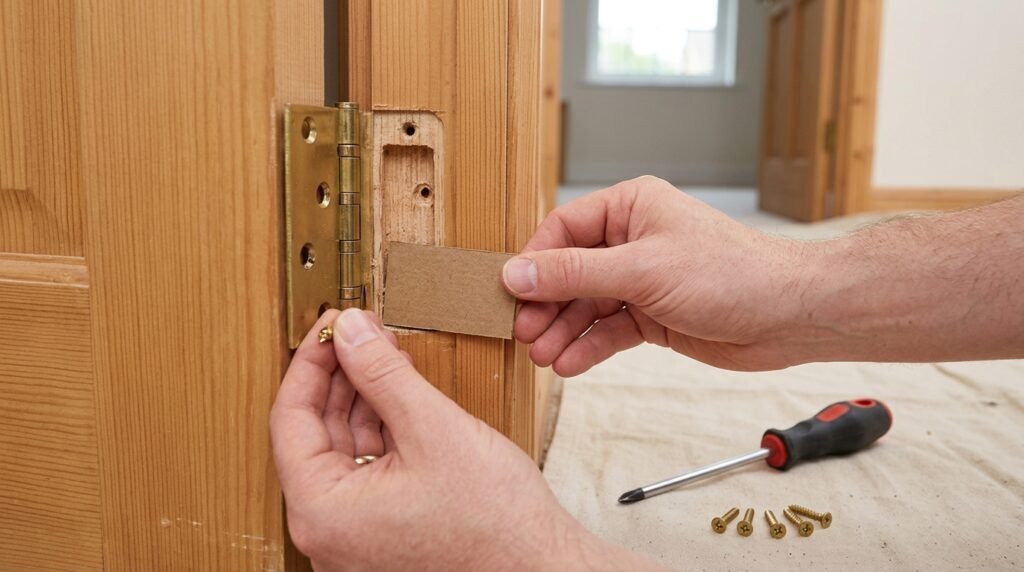
This fixes the actual cause instead of adding friction. You’re packing out one hinge with thin cardboard so the hinge line becomes vertical again.
- Work out the lean. If the door drifts shut, the top of the hinge line leans toward the room the door closes into. Usually you shim the bottom hinge outward, or the top hinge on the other diagonal.
- Open the door and support it underneath with a book or wedge.
- Unscrew the leaf of the chosen hinge from the frame only, leaving it attached to the door.
- Cut a piece of cereal-box cardboard to the shape of the hinge mortise, drop it in, and screw the hinge back through it. One thickness at a time.
- Test the drift. Add a second layer if needed. Two layers of cereal box, roughly 1 mm, corrects most drifting doors.
If a hinge screw spins uselessly while you’re in there, the hole is stripped, and it’s the same two-minute repair as a saggy cabinet door: How to Fix Loose Cabinet Hinge Screw Holes. Use the toothpick method with proper 3-inch screws for the frame side of door hinges, since those carry real weight.
Fix 5: A Friction Hinge or Adjustable Door Holder ($10–$15)
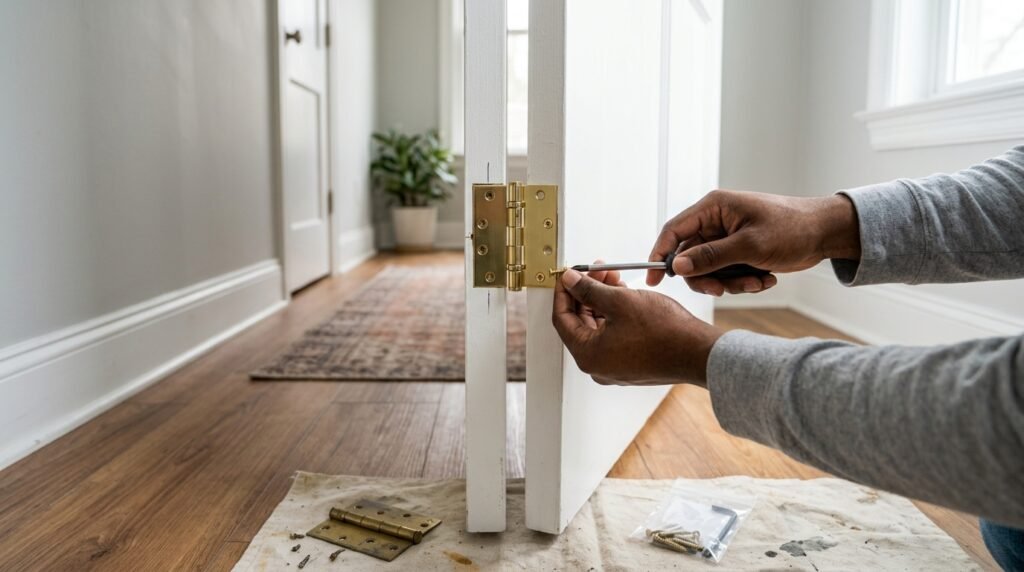
For a long-term, clean-looking solution, swap one standard hinge for a friction hinge, which has adjustable tension built into the knuckle. Turn a small screw to dial in exactly how much hold you want. Installation means removing one hinge and screwing the new one into the same holes and mortise, so it’s a fifteen-minute job with no chiseling if you match the hinge size (measure yours, most interior doors use 3.5-inch hinges). It’s the fix I’d pick for a door you adjust often, like a nursery door you want to stay at exactly one-third open.
What NOT to Do
- Don’t bend the pin dramatically. A sharply kinked pin can jam permanently and gall the hinge knuckles. Tiny bow, test, repeat.
- Don’t shim with paper. It compresses to nothing in weeks. Cardboard or plastic shim stock only.
- Don’t plane or sand the door. Self-closing is a hinge-alignment problem, not a door-size problem. Removing material fixes nothing here and can’t be undone.
- Don’t ignore a door that recently changed behavior. A door that suddenly starts swinging can signal fresh settling or a moisture problem swelling the frame, worth a look before winter.
FAQs
Will bending the hinge pin damage the door or hinge?
Done gently, no. The pin is a sacrificial, replaceable part, and a slight bow just adds friction inside the knuckles. Worst case you overdo it, the door feels stiff, and you pull the pin back out and straighten it on the same concrete step. New pins cost about a dollar each at any hardware store if you ever mangle one.
Why does my door only swing shut sometimes?
Usually humidity or airflow. Wood doors and frames swell and shrink with the seasons, which can shift the balance point just enough. Open windows create pressure differences that push doors around too. If it’s seasonal, the felt pad or pin trick handles both conditions. If it’s draft-driven, watch which windows are open when it happens.
Is the hinge pin trick okay in a rental?
It’s about as renter-safe as a fix gets. Nothing is drilled, glued, or visibly altered, and the pin can be straightened or replaced for a dollar when you move out. If you want truly zero alteration, use the felt pad or a doorstop instead.
My door swings open instead of shut. Same fix?
Same physics, opposite lean. The friction fixes (bent pin, felt pad) work identically in both directions. If you go the shimming route, you’ll shim the opposite hinge from the drift-shut case. Diagnose with a spirit level held against the hinge edge of the frame and shim toward vertical.
The door won’t stay open AND rubs the floor. What’s going on?
That combination usually means the top hinge screws have pulled loose, letting the whole door sag and tilt at once. Tighten the top hinge first, using 3-inch screws that reach the wall stud behind the frame if the originals spin. Fixing the sag often fixes the drift in the same move, no pin-bending required.
Pingback: Weekend Fixes Under $25: Easy Home Repairs for Renters - The Home Perk
Pingback: How to Hang Heavy Things Without Drilling (Renter-Safe) - The Home Perk