
You can organize small closet space properly for under $50, and most of that budget goes on three things: matching slim hangers, a hanging shelf organizer, and a couple of bins for the shelf up top. The rest is free, because the biggest gains in a small closet come from taking half your stuff out of it and using the vertical space you already have. Custom closet systems are lovely, but they solve a problem that a $12 tension rod solves nearly as well.
This works whether you’ve got a shallow reach-in closet, a single wardrobe, or one sad rail behind a sliding door that comes off its track if you look at it wrong.
First, Empty It Completely
Not one section at a time. All of it, onto the bed. This feels dramatic, and that’s the point. You can’t organize a small closet around clothes that shouldn’t be in it, and you can’t judge what should stay while it’s hidden in a squashed row.
Sort into four piles:
- Wearing regularly. Back in the closet, best spots.
- Seasonal. Winter coats in July don’t deserve prime rail space. They go up top or under the bed.
- Doesn’t fit, damaged, or you just don’t like it. Donate or toss. Be honest here. The “might fit again someday” pile is where closet space goes to die.
- Sentimental but never worn. One box, sealed, stored somewhere that isn’t your only closet.
If you can’t decide on something, try the backwards hanger trick: hang everything with the hook facing you, and flip each hanger the normal way after you wear the item. Six months from now, anything still backwards has answered the question for you.
Swap to Slim Matching Hangers
This sounds cosmetic. It isn’t. Chunky mismatched hangers, especially wooden ones and the free wire ones from the dry cleaner, waste a shocking amount of rail. Slim velvet-flocked hangers are about a third the thickness, so a packed rail suddenly gains 20 to 30 percent more room, and clothes stop slithering onto the floor.
A 50-pack runs about $20 and it’s the single best purchase in this entire project. Buy one color. The uniform look also makes the closet feel calmer, which sounds silly until you see it.
Double the Hanging Space
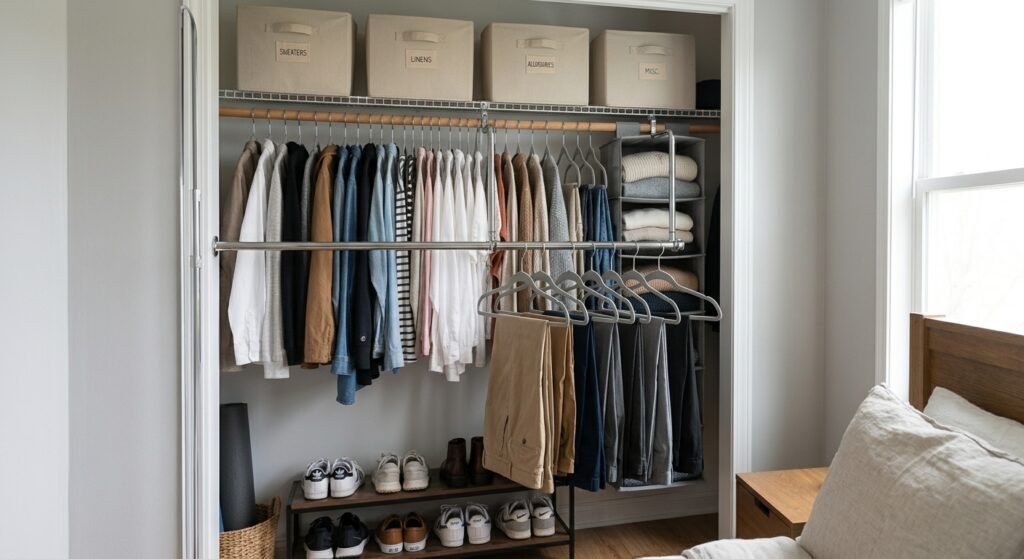
Most closets have one rail with a metre of dead air below the shirts. Reclaim it:
- A hanging second rod (sometimes called a closet doubler) hooks over your existing rail and drops a second rail below it. Tops on the upper rail, trousers and skirts folded over hangers on the lower one. No tools, around $15.
- A tension rod can do the same job inside a wardrobe or alcove, wedged between the side walls below the main rail. Don’t overload it, and give it a hard downward tug to test before trusting it with your work shirts.
- Soda can tabs are the free version of a cascading hanger: slip the tab over a hanger hook, and hang a second hanger through the lower hole. Great for outfits or doubling up light tops.
If the closet’s own rod is loose in its bracket and wobbles, fix that before loading it further. It’s usually a stripped screw hole, and the repair is the same toothpick-and-glue trick we use on cabinet hinges: How to Fix Loose Cabinet Hinge Screw Holes.
Use the Door, the Floor, and the Shelf Properly
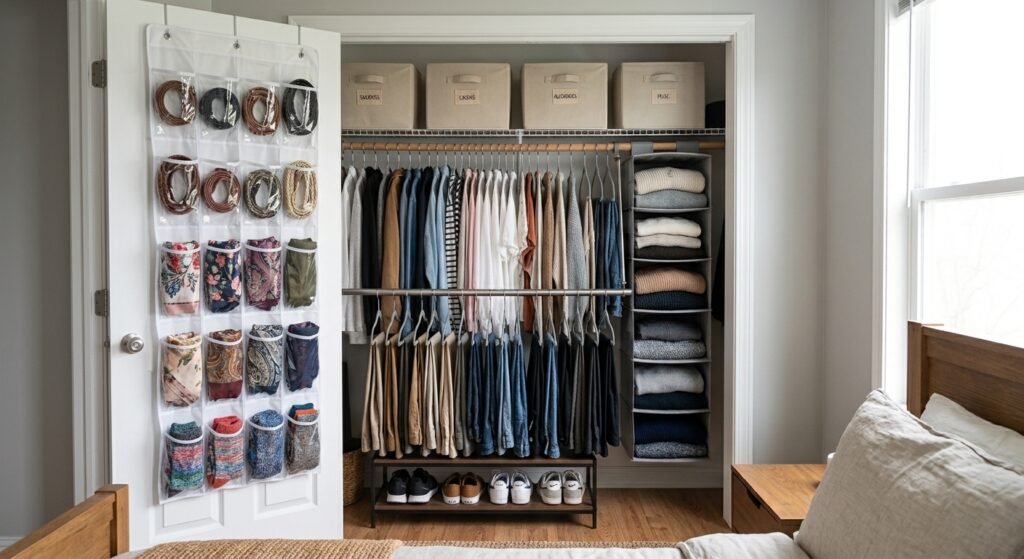
A small closet has three neglected areas, and they’re usually a mess in the same predictable ways.
The back of the door
An over-door shoe organizer is the classic for a reason, and not just for shoes. The clear pockets hold belts, scarves, clutch bags, socks, phone chargers, whatever small stuff currently lives in a pile. If your door is a sliding one, put the organizer on a nearby wall with adhesive hooks instead, and check what those hooks can hold first in our guide to hanging heavy things without drilling.
The floor
Closet floors default to shoe soup. Two fixes: a small shoe rack (stackable wire ones are about $10), or clear stacking boxes if you own more shoes than rack. Boxes also stop dust settling on the pairs you rarely wear. Leave a small gap of visible floor if you can. Weirdly, a bit of empty floor makes the whole closet read as tidy.
The top shelf
The top shelf fails because things get piled loose and then avalanche. Bins fix it. Two or three fabric bins or lidded boxes turn the shelf into labeled storage for seasonal clothes, spare bedding, or bags. Label the front. You will not remember which bin is which, no matter how sure you are right now.
Add Shelving Without Tools
A hanging fabric shelf organizer clips over the rail and gives you five or six cubbies for jumpers, jeans, and t-shirts. It’s the renter’s answer to built-in shelves: around $15, installs in ten seconds, leaves no trace. Fold knitwear into these rather than hanging it, since hangers stretch shoulders out of shape anyway.
Small stacking drawers on the closet floor do a similar job for underwear and socks if your bedroom lacks a dresser. Plastic ones are fine hidden behind a closed door, and they free up a whole section of rail-adjacent chaos.
One thing to skip: those hanging organizers with fifteen tiny compartments for jewelry and accessories. They tangle, they twist, and they eat rail space. A drawer tray does the same job better.
Keep It Working
The system decays if the closet becomes a one-way door. Three habits keep it alive:
- One in, one out for hangers. When the slim hangers are full, something leaves before something new gets hung. The fixed number of hangers becomes your closet’s natural limit.
- Seasonal swap twice a year. Off-season clothes trade places with the top-shelf bins. It takes twenty minutes and makes the closet feel twice as big for the next six months.
- The doom-pile chair gets a rule. Clothes worn once but not dirty go on designated hooks or one dedicated basket, not draped over everything. Contained mess is fine. Spreading mess isn’t.
While you’ve got everything out, it’s worth vacuuming the closet floor and wiping the shelf, because that’s a surface that gets cleaned roughly never. If the closet smells musty, that’s usually poor airflow, so leave the door cracked open for a few days and don’t pack clothes tight against an external wall.
FAQs
What’s actually worth buying if I can only spend $20?
Slim matching hangers. Nothing else comes close on space gained per dollar. If you’ve got $5 left after that, add a soda-can-tab cascade setup for free and put the $5 toward a shoe rack.
How do I organize a small closet I share with a partner?
Split it vertically, not horizontally. Each person gets a full top-to-bottom section rather than one person getting the rail and the other getting shelves. Then apply the hanger limit to each side separately, or one person’s overflow quietly annexes the other’s territory. Ask me how I know.
Should I fold or hang if space is tight?
Hang the things that wrinkle or hold their shape on a hanger: shirts, dresses, blazers, trousers. Fold the heavy and stretchy stuff: knitwear, t-shirts, jeans, gym clothes. In a small closet, folded items in a hanging cubby organizer usually pack denser than the same clothes on hangers.
Where do I put off-season clothes with no spare closet?
Under the bed is the standard answer, in flat zippered bags or low-profile boxes. Vacuum-seal bags shrink puffy coats and duvets to a third of their size, though give them a day to re-fluff when they come out. A sealed bin on top of a wardrobe or at the back of a top shelf works too.
My closet rod sags in the middle. Is that fixable cheaply?
Yes. A rod that sags but hasn’t broken just needs a center support bracket, a few dollars at any hardware store, and it usually screws into the shelf above rather than the wall. If you can’t put screws anywhere, an adjustable floor-standing closet support pole props the rod from below. Also take some weight off it: winter coats are usually the culprit.