
The fastest safe way to remove hard water stains from a black faucet is a 1:1 mix of white vinegar and warm water: dampen a microfiber cloth with the solution, drape it over the stained areas for 10-15 minutes, then wipe with the grain and buff dry with a clean, dry microfiber cloth. Never use abrasive pads, powdered cleansers, bleach, or undiluted vinegar left on for long periods. Black faucets (especially matte black) have a coated finish that scratches and dulls far more easily than chrome.
Those white, chalky spots show up so dramatically on black fixtures because hard water minerals, mostly calcium and magnesium, are light-colored. On chrome you barely notice them. On black, every droplet leaves a ghost. The good news: the fix is cheap, takes about 15 minutes, and uses things you already have.
Why Black Faucets Need Gentler Treatment Than Chrome
Most black faucets aren’t solid black metal. They’re brass or zinc underneath, with a black finish applied on top, usually a powder coat or a PVD (physical vapor deposition) coating. PVD is tougher; powder coat is more common on budget fixtures and scratches more easily. Either way, the rule is the same: you’re cleaning a coating, not bare metal.
That means:
- Abrasives (scrub pads, magic erasers, scouring powder) leave permanent hazy scratches that show badly on dark finishes.
- Harsh acids (CLR-type descalers, undiluted vinegar soaked overnight) can etch or lighten the coating.
- Bleach and ammonia can discolor the finish and void most manufacturer warranties.
Diluted vinegar, used for short contact times and rinsed off, is safe for nearly all black finishes. If your faucet came with care instructions, check them. A few manufacturers ask you to avoid vinegar entirely and use only dish soap. When in doubt, test on the back of the faucet base first.
What You’ll Need
- White distilled vinegar
- Warm water
- 2–3 clean microfiber cloths (soft, not the scrubby kind)
- A small bowl or spray bottle
- Dish soap (plain, no bleach or “antibacterial degreaser” formulas)
- Old soft toothbrush (optional, for around the base and aerator)
- Zip-top sandwich bag and a rubber band (for a crusted aerator)
That’s it. Skip the specialty “black fixture cleaner” sprays unless you just prefer them. Most are diluted acid, which you can make for pennies.
How to Remove Hard Water Stains from a Black Faucet: Step by Step
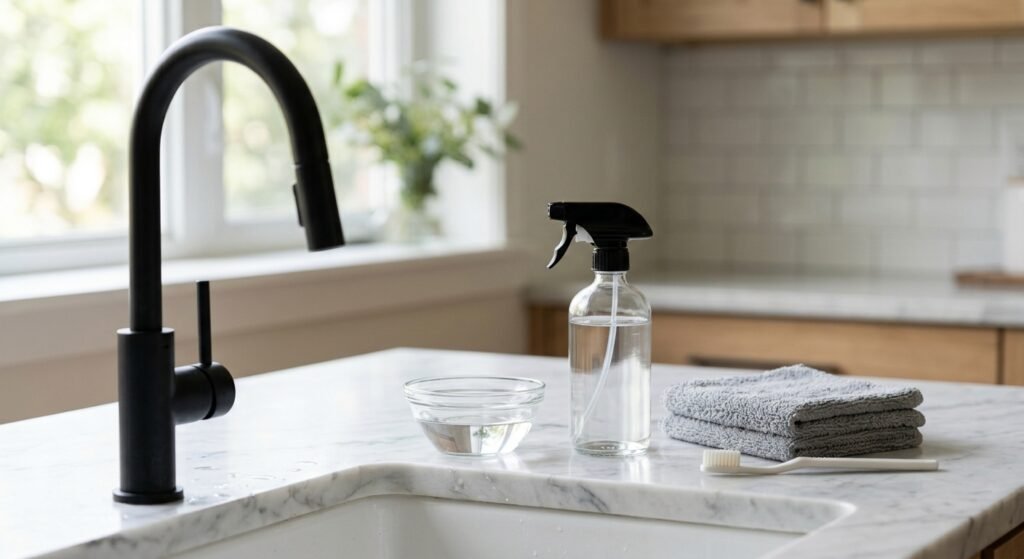
- Rinse and wipe first. Run warm water over the faucet and wipe it down with a damp microfiber cloth. This removes loose grime so you’re not rubbing grit into the finish. That’s how most “cleaning scratches” actually happen.
- Mix your solution. Combine equal parts white vinegar and warm water (1:1) in a bowl or spray bottle. For light spotting, you can go weaker: 1 part vinegar to 2 parts water.
- Apply with a soaked cloth, not a spray-and-scrub. Soak a microfiber cloth in the solution, wring it lightly, and drape or wrap it over the stained areas. For the spout and handle, mold the wet cloth around them.
- Wait 10–15 minutes. The acid needs contact time to dissolve the mineral deposits. Don’t exceed 30 minutes on a coated finish.
- Wipe gently with the grain. Remove the cloth and wipe the softened deposits away using light pressure. For stubborn crust around the base or seams, use a soft toothbrush dipped in the solution, gentle circles, no force.
- Rinse thoroughly. Wipe the entire faucet with a cloth dampened in plain water. Leftover vinegar residue can dull the finish over time.
- Dry and buff. This step matters more than any other on black fixtures: buff completely dry with a fresh, dry microfiber cloth. Water you leave behind becomes tomorrow’s spots.
For a Crusted Aerator (the Screen at the Spout Tip)
If water sprays unevenly or the tip is caked white, fill a sandwich bag with the 1:1 vinegar solution, submerge the spout tip in it, and secure the bag with a rubber band. Leave it 20–30 minutes (no longer on black finishes), remove, scrub the tip gently with the toothbrush, rinse, and dry. If the aerator unscrews, even better. Soak just the aerator in a cup of solution for an hour instead, keeping the acid off the finish entirely.
For Heavy, Old Buildup
Repeat the compress method twice rather than scrubbing harder or using stronger acid. Two gentle 15 minute sessions beat one aggressive attack every time. If deposits still won’t budge, make a loose paste of baking soda and water (3:1), apply it with your fingertip only to the mineral crust itself, let it sit 5 minutes, and wipe away with a wet cloth. Baking soda is mildly abrasive, so keep it on the deposit, not the surrounding finish, and never scrub with it.
What NOT to Do on a Black Faucet
- No melamine sponges (magic erasers). They work like ultra-fine sandpaper and will leave a permanently lighter, hazy patch.
- No scouring powders or cream cleansers. Same problem: micro-scratches that scatter light and gray out the finish.
- No steel wool, scrub pads, or the rough side of a sponge. Ever.
- No bleach, ammonia, or glass cleaners containing ammonia. These can chemically discolor coatings.
- No industrial descalers or rust removers unless the label specifically says safe for matte black/PVD finishes.
- Don’t let vinegar dwell for hours or overnight. Short contact, then rinse.
- Don’t air-dry. Air-drying is what created the stains in the first place.
- If you’ve inherited a faucet with existing scratches or a patch someone already dulled, cleaning won’t reverse it. But a tiny amount of mineral oil buffed in can visually even out light hazing on matte finishes. The same care rules apply to shower heads and towel bars; see our full guide on how to clean matte black fixtures the right way.
How to Keep Hard Water Stains from Coming Back
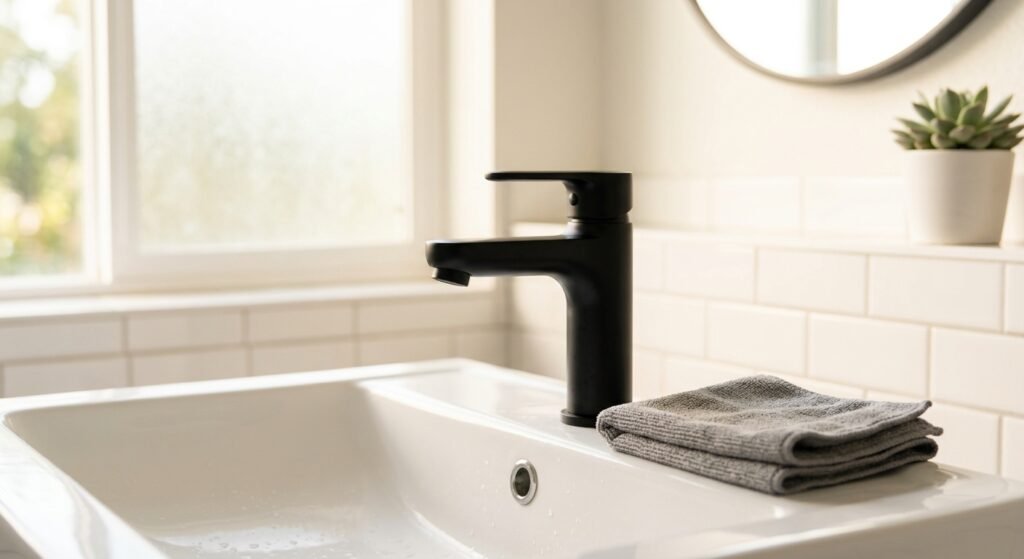
Prevention takes 10 seconds a day and beats every cleaning method:
- Keep a dry microfiber cloth by the sink and give the faucet a quick wipe after the last use each evening. No water left = no minerals left.
- Once a week, wash the faucet with a drop of dish soap on a damp cloth, rinse, and buff dry.
- Once a month (or when you first see faint spots), do the 1:1 vinegar wipe-down, a 2-minute wipe, not the full compress treatment.
- Consider a squeegee habit if your bathroom fixtures and glass all spot quickly. Hard water that stains your faucet is also building up on your shower glass. Here’s how to deal with that: cleaning glass shower doors with hard water buildup.
If every fixture in your home spots within a day of cleaning, your water is likely very hard (over ~180 ppm). Test strips cost a few dollars, and if you’re a homeowner, a water softener becomes worth pricing out. Renters: the wipe-dry habit is your best friend.
The same ‘gentle acid, short contact, buff dry’ logic applies to other delicate kitchen surfaces too. For example, greasy film on painted surfaces needs a similarly cautious approach: removing grease from painted cabinets safely.
FAQs
Does vinegar damage black faucets?
Diluted vinegar (1:1 with water) used for 10–15 minutes and rinsed off is safe for almost all black finishes, including matte black and PVD. Damage happens with undiluted vinegar left on for hours, or repeated long soaks. Always rinse and dry after using vinegar, and check your faucet’s care card. A small number of manufacturers recommend dish soap only.
How do I get my black faucet shiny again?
After removing mineral deposits, buff the dry faucet with a clean microfiber cloth. On matte black, a drop of mineral oil rubbed in with a soft cloth and buffed off restores an even, rich look. Avoid wax or polish sprays not rated for your finish. Some leave a splotchy film on matte coatings.
Can I use a magic eraser on a matte black faucet?
No. Melamine foam is a micro-abrasive and will permanently scratch and lighten the coating. The damage often isn’t visible while wet. It shows up as a hazy gray patch once the faucet dries.
Why does my black faucet spot so fast after cleaning?
You likely have hard water, and droplets left to air-dry deposit minerals within hours. Buff the faucet dry after cleaning and wipe it down after the day’s last use. If spotting is extreme, test your water hardness. Anything above roughly 180 ppm counts as very hard.
Will CLR or Lime-A-Way ruin a black faucet?
They can. Most heavy-duty descalers are formulated for chrome, porcelain, and glass, and their labels specifically warn against use on painted, coated, or matte finishes. Unless the product explicitly lists black/PVD/matte fixtures as safe, stick with diluted vinegar.
Pingback: How to Clean Matte Black Fixtures the Right Way (What to Never Use) - The Home Perk
Pingback: How to Clean Glass Shower Doors with Hard Water Buildup - The Home Perk