
Houseplants that survive low light do exist, and they’re the difference between a green apartment and a windowsill of crispy regrets. If your flat faces north, looks out at a brick wall, or gets exactly forty minutes of direct sun filtered through a neighbor’s balcony, you’re not locked out of plants. You just need the specific ones that evolved on dim forest floors, plus a watering habit adjusted for how slowly things dry in a dark room. That second part is where most low-light plants actually die, and we’ll cover it properly.
First, a quick reality check, then the plants.
What “Low Light” Actually Means (And What It Doesn’t)
Low light means a room where you can comfortably read during the day without a lamp, but no direct sun ever lands. A few meters back from a north window, a spot beside an east window, a bright hallway. That’s low light, and the plants below handle it.
What no plant handles is no light. A windowless bathroom, a dark corner three rooms from any window, a basement flat’s inner hallway. Photosynthesis needs some light, full stop. A useful test: if you can’t easily read a book there at midday with the lights off, a live plant will slowly starve in that spot. For truly dark corners, either rotate a plant in and out every couple of weeks, add a small grow bulb in an ordinary lamp, or make peace with a fake plant. No shame in it, some of the fakes are genuinely convincing now.
The Plants That Actually Cope
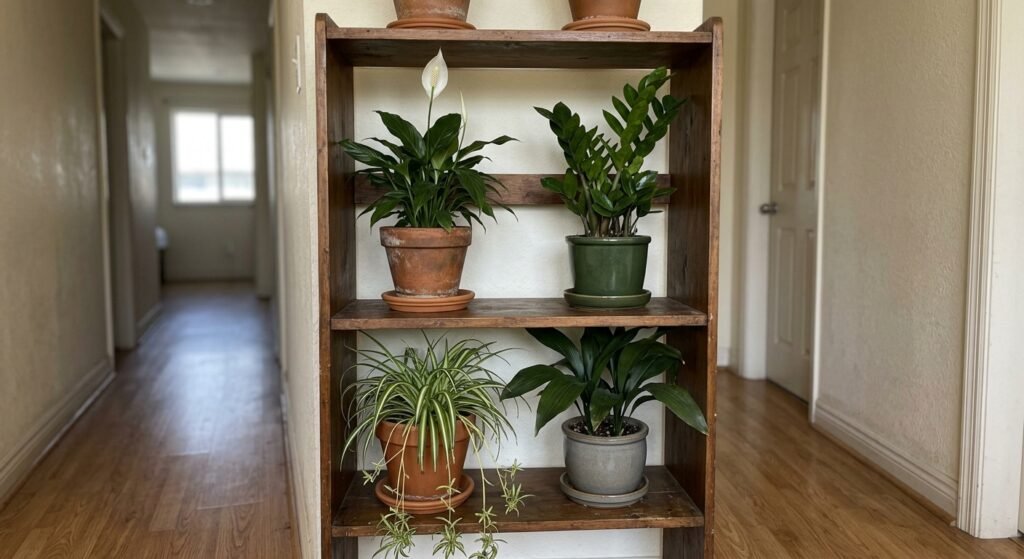
These are the reliable ones, roughly in order of how hard they are to kill.
Snake plant (Sansevieria). The tank of the houseplant world. Upright sword-shaped leaves, handles dim corners, dry air, and being ignored for a month. Its one weakness is overwatering. In low light, watering once every three to four weeks is genuinely enough.
ZZ plant (Zamioculcas). Glossy, almost plastic-looking leaves and thick underground rhizomes that store water. It tolerates darker spots than nearly anything else and grows slowly, which in a small flat is a feature. Same rule: water rarely.
Pothos. A trailing vine that grows in offices with no windows in sight. It’s forgiving, fast enough to feel rewarding, and tells you clearly when it’s thirsty by wilting slightly, then perks up within hours of a drink. Trail it off a shelf or bookcase where floor space is tight.
Heartleaf philodendron. Similar to pothos, heart-shaped leaves, happy in a dim living room. Both look great cascading from the top of a wardrobe, which uses exactly zero floor space.
Peace lily. One of the few low-light plants that flowers. It droops theatrically when thirsty and recovers fast, so it basically waters itself through you. It likes more moisture than the others here.
Cast iron plant (Aspidistra). Named honestly. Victorian parlors kept these alive with gas lighting and coal smoke. Slow-growing, deep green, and nearly indifferent to neglect.
Spider plant. Handles low light, bounces back from most abuse, and produces baby plantlets you can pot up for free plants or gifts.
A note on pets: snake plants, ZZ plants, pothos, philodendron, and peace lilies are all toxic to cats and dogs if chewed. Spider plants and cast iron plants are the pet-safe picks on this list, so lead with those if you’ve got a leaf-chewer at home.
The Watering Adjustment Everyone Misses
Here’s the thing that kills more low-light plants than the dim room itself: soil in low light dries painfully slowly. Less light means slower growth, which means the plant drinks less, and no sun means less evaporation. A pot that dried in a week on a sunny sill can stay wet for three in a dark corner.
So the schedule you learned from plant care in general, or from a sunnier apartment, will drown these plants. What works instead:
- Check, don’t schedule. Finger 2 to 3 cm into the soil. Still damp? Wait. For snake plants and ZZ plants, wait until the pot feels light when lifted.
- Water thoroughly when you do, until it runs from the drainage hole, then empty the saucer.
- Expect winter to slow everything further. Some low-light plants want water only monthly from November to February.
Yellowing, mushy lower leaves and soil that smells swampy mean overwatering. Crispy brown leaf tips and soil pulling away from the pot’s edge mean the rare opposite. The same read-the-plant approach applies outdoors too, and our guide on how often to water container plants goes deeper on the warning signs.
Every pot still needs a drainage hole, low light or not. Sitting water plus slow drying is root rot on easy mode.
Small Tricks That Squeeze More Light From a Dim Flat
You can’t move the windows, but you can waste less of what they give you:
- Clean the glass. Sounds silly, but city window grime eats a real fraction of incoming light, especially on the outside.
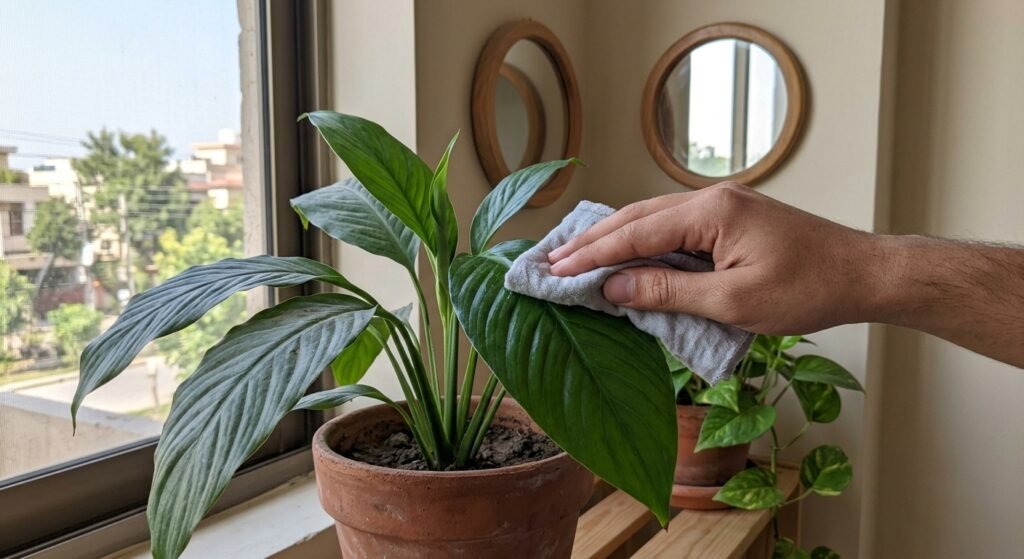
- Keep leaves dust-free. A dusty leaf photosynthesizes noticeably worse. Wipe the big-leaved plants (ZZ, peace lily, cast iron) with a damp cloth every month or so.
- Use mirrors and pale walls. A mirror opposite the window genuinely bounces usable light deeper into the room.
- Rotate pots a quarter turn weekly, or everything grows lopsided toward the glass.
- Pull plants closer to windows in winter. Light levels drop hard from October to March in the US and UK, and a plant coping fine in July can starve in January two meters further into the room.
- Consider one cheap grow bulb. A full-spectrum LED bulb screws into a normal lamp and turns any reading corner into a plant corner for under $15.
If your only decent light is out on a balcony, it’s worth splitting your collection: tough, sun-loving things outside and the shade-tolerant crew indoors. For the outdoor half, our roundup of low maintenance balcony plants pairs well with this list.
Popular Plants to Skip in a Dark Flat
Plenty of trendy plants get sold as easy but quietly need real light. In a dim apartment, skip succulents and cacti (they stretch into pale, leaning versions of themselves within weeks), fiddle leaf figs (famously dramatic even in good light), most flowering plants, and herbs. Herbs are the one people try hardest to force, and they just get leggy and flavorless without sun. If fresh herbs are the goal, a bright sill or a small grow light setup changes everything, and our indoor herb garden for beginners guide covers exactly that.
Buying a plant labeled “low light tolerant” also deserves one caveat: tolerant means survives, not thrives. Expect slower growth and smaller leaves than the lush shop specimen, which was grown in a bright greenhouse. That’s normal, not failure.
FAQs
Will a plant really survive in my windowless bathroom?
A live one, no, not long-term. No window means no photosynthesis, and even the toughest plants slowly deplete their reserves in the dark. Options: rotate two plants between the bathroom and a brighter room every week or two, add a small grow bulb to the light fixture, or use a good fake. The humidity in there is lovely for plants, it’s purely the light that’s missing.
How do I know if my plant isn’t getting enough light?
Watch for stretching: long gaps between leaves, thin pale growth, and the whole plant leaning hard toward the window. New leaves coming in much smaller than old ones is another tell. The fix is moving it closer to the glass or adding a bulb, not more water or fertilizer.
Do low light plants need fertilizer?
Barely. Slow growth means low appetite. A liquid feed at half strength once a month through spring and summer is plenty, and none at all in winter. Overfeeding a slow-growing plant in a dim room just builds up salts in the soil.
Which of these is best for a total beginner who travels a lot?
Snake plant or ZZ plant, no contest. Both shrug off a month of neglect in low light. Water before you leave, and don’t let anyone helpfully water them while you’re gone. That favor kills more of them than any holiday.
Can I use a normal desk lamp as a grow light?
A standard old bulb, not really, but swap in a full-spectrum LED grow bulb and yes, an ordinary lamp becomes a legitimate grow light. Keep it 20 to 40 cm above the plant and run it 10 to 12 hours a day on a cheap timer. For one or two plants, this beats buying dedicated grow-light fixtures.